Word Explanation
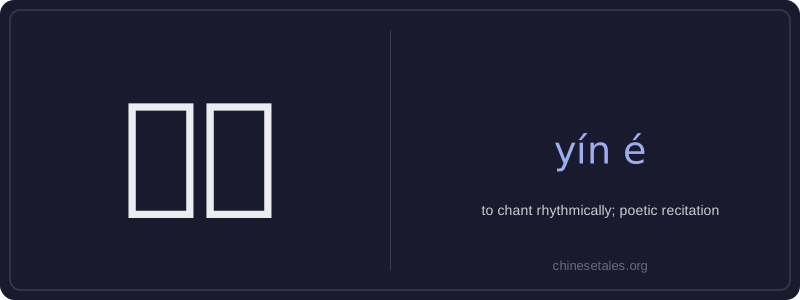
‘吟哦’ is a literary, rhythmic verb meaning to chant or recite poetry aloud with feeling and cadence—often slowly, melodiously, and expressively. The first character 吟 (yín) means 'to chant' or 'to hum poetically', commonly associated with classical Chinese poetry; the second character 哦 (é) is an interjection-like particle here that reinforces the vocal, expressive quality—not to be confused with its more common use as a conversational 'oh'. Together, 吟哦 evokes a meditative, artistic act of vocalizing verse, emphasizing tone, rhythm, and emotional resonance.
This word appears mainly in formal, literary, or descriptive contexts—such as essays about poets, historical accounts of scholars, or lyrical descriptions of quiet study. It carries a refined, somewhat archaic or elevated register and is rarely used in casual speech. You’ll often find it paired with nouns like 诗词 (shīcí, 'poetry'), 古诗 (gǔshī, 'classical poems'), or 名篇 (míngpiān, 'famous pieces'). It suggests deep engagement, not mere reading—it’s about embodying the poem through voice.
Example Sentences
Related Words
国语
‘Guó yǔ’ literally means 'national language'—
无论谁
‘无论谁’ (wú lùn shéi) is a pronoun meaning
外语
‘外语’ literally means ‘outside language’ —
不对
不对 (bù duì) literally combines 不 (bù), meani
我的
我的 (wǒ de) is a possessive pronoun meaning 'my'
违规
违规 (wéi guī) literally means 'to violate rules
亲笔
‘亲笔’ literally means ‘one’s own hand’—comb
面条
‘面条’ (miàn tiáo) literally means ‘flour str