Word Explanation
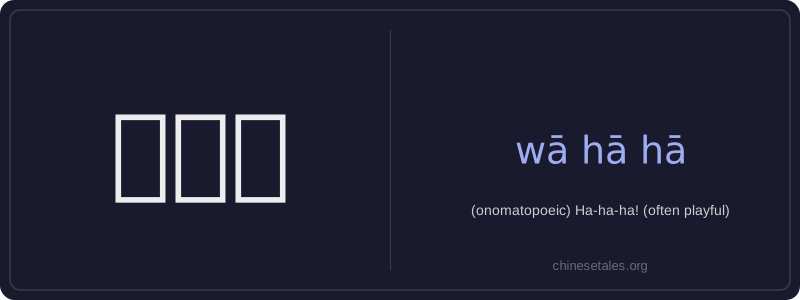
'Wā hā hā' is an onomatopoeic interjection that mimics loud, playful, or slightly exaggerated laughter — like 'Ha-ha-ha!' in English. Though it uses three characters, it functions as a single expressive unit, not a compound word with literal meaning. The first character 哇 (wā) adds a burst of surprise or delight, while the repeated 哈 (hā) intensifies the laughter, giving it a lighthearted, childlike, or teasing tone.
This expression is commonly used in informal spoken Chinese — especially among friends, children, or in online chats — to convey amusement, mock astonishment, or cheerful sarcasm. It’s rarely written in formal contexts and almost never used alone as a complete sentence; instead, it appears mid-sentence or as a reaction. Unlike neutral laughter markers like 哈哈 (hā hā), 哇哈哈 carries extra emotional color: it suggests spontaneity, playfulness, or gentle mockery rather than simple mirth.
Example Sentences
Related Words
国语
‘Guó yǔ’ literally means 'national language'—
无论谁
‘无论谁’ (wú lùn shéi) is a pronoun meaning
外语
‘外语’ literally means ‘outside language’ —
不对
不对 (bù duì) literally combines 不 (bù), meani
我的
我的 (wǒ de) is a possessive pronoun meaning 'my'
违规
违规 (wéi guī) literally means 'to violate rules
亲笔
‘亲笔’ literally means ‘one’s own hand’—comb
面条
‘面条’ (miàn tiáo) literally means ‘flour str