Word Explanation
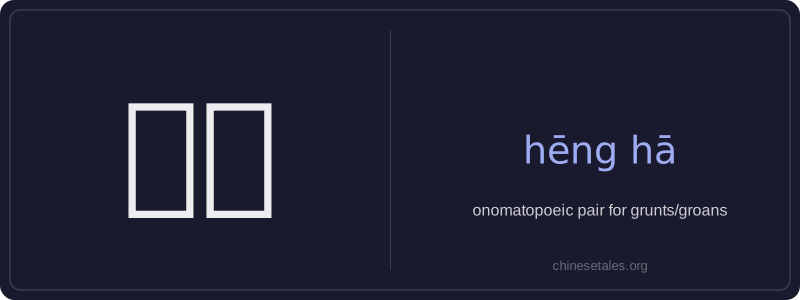
'Hēng hā' is a reduplicative onomatopoeic expression that mimics short, breathy grunts or groans — often involuntary sounds made during physical exertion, mild discomfort, or playful resistance. Though written with two distinct characters (哼 and 哈), together they function as a fixed pair, not as separate words. The first character 哼 typically suggests a nasal, closed-mouth grunt, while 哈 adds an open-mouthed, exhaled puff — their combination evokes rhythmic, effortful breathing.
This term appears frequently in descriptive writing, children’s stories, and cartoons, especially when portraying animals (like pigs or bears straining), cartoonish characters lifting heavy objects, or people pretending to be strong or stubborn. It carries a light, slightly humorous or exaggerated tone and is rarely used in formal speech or serious contexts. Unlike standalone 哼 (which can express disdain) or 哈 (which often signals laughter), the paired form 'hēng hā' is almost exclusively sound-based and context-dependent.
Example Sentences
Related Words
国语
‘Guó yǔ’ literally means 'national language'—
无论谁
‘无论谁’ (wú lùn shéi) is a pronoun meaning
外语
‘外语’ literally means ‘outside language’ —
不对
不对 (bù duì) literally combines 不 (bù), meani
我的
我的 (wǒ de) is a possessive pronoun meaning 'my'
违规
违规 (wéi guī) literally means 'to violate rules
亲笔
‘亲笔’ literally means ‘one’s own hand’—comb
面条
‘面条’ (miàn tiáo) literally means ‘flour str