Word Explanation
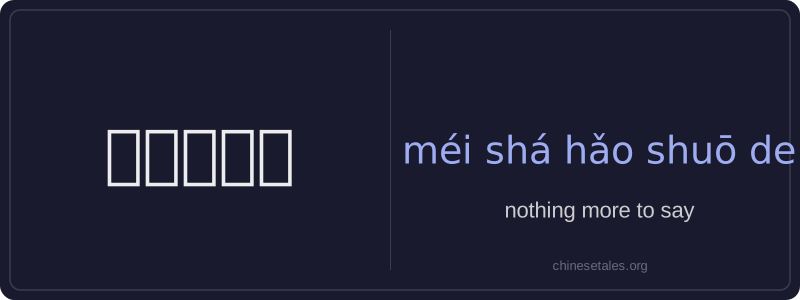
'Méi shá hǎo shuō de' is an informal, conversational phrase that literally breaks down as 'no (没) what (啥) good (好) to say (说) [particle] (的)' — expressing resignation, dismissal, or the feeling that further explanation is unnecessary or pointless. It often carries a tone of mild frustration, indifference, or weary acceptance, and is commonly used in spoken Mandarin when someone has nothing meaningful, constructive, or worth adding to a situation.
This phrase functions as a complete utterance — not a noun or verb, but a pragmatic interjection conveying attitude more than information. It’s frequently heard in casual conversations among friends, family, or colleagues after an argument, a minor failure, or an obvious outcome. While grammatically built from common words, its meaning isn’t fully predictable from individual characters; it’s a fixed idiomatic expression whose force lies in its rhythm and tone, especially when delivered with a sigh or shrug.
Example Sentences
Related Words
国语
‘Guó yǔ’ literally means 'national language'—
无论谁
‘无论谁’ (wú lùn shéi) is a pronoun meaning
外语
‘外语’ literally means ‘outside language’ —
不对
不对 (bù duì) literally combines 不 (bù), meani
我的
我的 (wǒ de) is a possessive pronoun meaning 'my'
违规
违规 (wéi guī) literally means 'to violate rules
亲笔
‘亲笔’ literally means ‘one’s own hand’—comb
面条
‘面条’ (miàn tiáo) literally means ‘flour str