Word Explanation
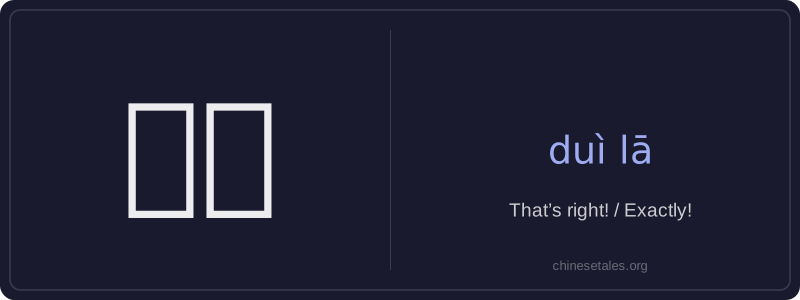
‘对啦’ is an enthusiastic, colloquial interjection used to express agreement, confirmation, or sudden realization — like saying 'That’s right!' or 'Exactly!' in English. It combines the adjective ‘对’ (duì), meaning 'correct' or 'right', with the sentence-final particle ‘啦’ (lā), which adds a light, conversational tone and implies immediacy or shared understanding. Unlike formal equivalents like ‘是的’ or ‘没错’, ‘对啦’ conveys warmth, friendliness, and often mild excitement.
This expression is common in informal spoken Chinese — among friends, family, or teachers responding to students’ correct answers. It frequently appears in dialogues where someone affirms another person’s statement or recalls something accurately. While it can stand alone as a response, it may also follow a clause for emphasis (e.g., ‘你记得啦?对啦!’). Its tone is upbeat but not overly emphatic, making it versatile yet distinctly casual.
Example Sentences
Related Words
国语
‘Guó yǔ’ literally means 'national language'—
无论谁
‘无论谁’ (wú lùn shéi) is a pronoun meaning
外语
‘外语’ literally means ‘outside language’ —
不对
不对 (bù duì) literally combines 不 (bù), meani
我的
我的 (wǒ de) is a possessive pronoun meaning 'my'
违规
违规 (wéi guī) literally means 'to violate rules
亲笔
‘亲笔’ literally means ‘one’s own hand’—comb
面条
‘面条’ (miàn tiáo) literally means ‘flour str