Word Explanation
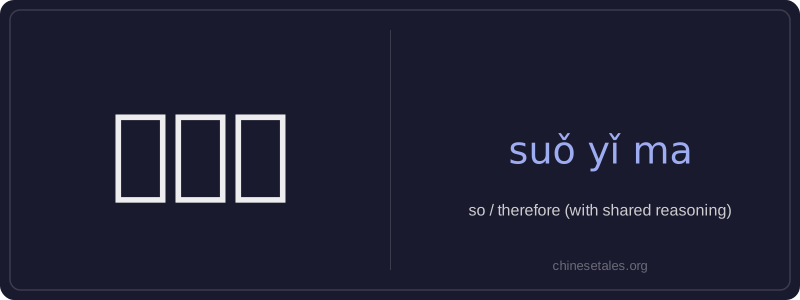
所以嘛 is a conversational conjunction and sentence-final particle that expresses a conclusion drawn from shared or previously mentioned information — often with a tone of mild emphasis, gentle persuasion, or light resignation. It combines 所以 (‘therefore’, ‘so’) with the modal particle 嘛, which signals common knowledge, obviousness, or mutual understanding between speaker and listener. Unlike formal 所以 alone, 所以嘛 softens the logical connection, making it sound more natural in spoken Chinese, especially in explanations, justifications, or casual reasoning.
This expression frequently appears in everyday dialogue — for instance, when reminding someone of an obvious cause-effect relationship, gently nudging them toward a decision, or wrapping up a short chain of reasoning. It’s rarely used in formal writing or academic contexts. The particle 嘛 adds warmth and interpersonal nuance, implying ‘as we both know’ or ‘don’t you see?’ without sounding abrupt or authoritarian.
Example Sentences
Related Words
国语
‘Guó yǔ’ literally means 'national language'—
无论谁
‘无论谁’ (wú lùn shéi) is a pronoun meaning
外语
‘外语’ literally means ‘outside language’ —
不对
不对 (bù duì) literally combines 不 (bù), meani
我的
我的 (wǒ de) is a possessive pronoun meaning 'my'
违规
违规 (wéi guī) literally means 'to violate rules
亲笔
‘亲笔’ literally means ‘one’s own hand’—comb
面条
‘面条’ (miàn tiáo) literally means ‘flour str