Word Explanation
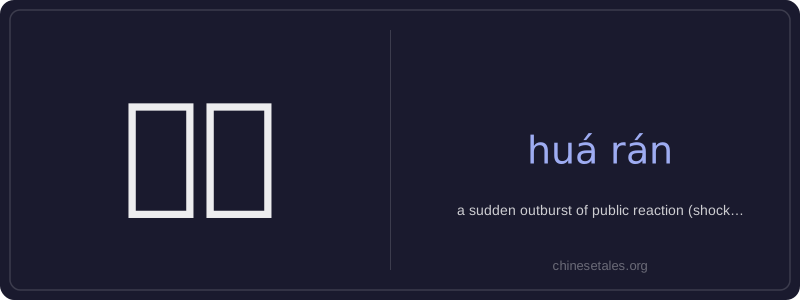
‘哗然’ is a literary noun describing a sudden, collective, and often loud public reaction—typically shock, disbelief, anger, or spontaneous laughter—that spreads quickly among a group of people. The first character 哗 (huá) means ‘to make a loud noise’ or ‘uproar,’ evoking clamor and commotion; the second character 然 (rán) functions as a suffix meaning ‘in such a manner’ or ‘thus,’ turning the compound into an abstract noun indicating the *state* or *phenomenon* of that uproar. Together, they emphasize not just noise, but the emotional resonance and social immediacy of the reaction.
This word is commonly used in formal writing, news reports, and literary descriptions—not in casual speech—to highlight how unexpectedly and powerfully a piece of news or action triggers widespread response. It often appears after verbs like ‘引起’ (to provoke), ‘顿时’ (immediately), or ‘全场’ (the entire venue), underscoring its collective and instantaneous nature. While it can describe laughter, it more frequently conveys negative or astonished reactions.
Example Sentences
Related Words
国语
‘Guó yǔ’ literally means 'national language'—
无论谁
‘无论谁’ (wú lùn shéi) is a pronoun meaning
外语
‘外语’ literally means ‘outside language’ —
不对
不对 (bù duì) literally combines 不 (bù), meani
我的
我的 (wǒ de) is a possessive pronoun meaning 'my'
违规
违规 (wéi guī) literally means 'to violate rules
亲笔
‘亲笔’ literally means ‘one’s own hand’—comb
面条
‘面条’ (miàn tiáo) literally means ‘flour str