Word Explanation
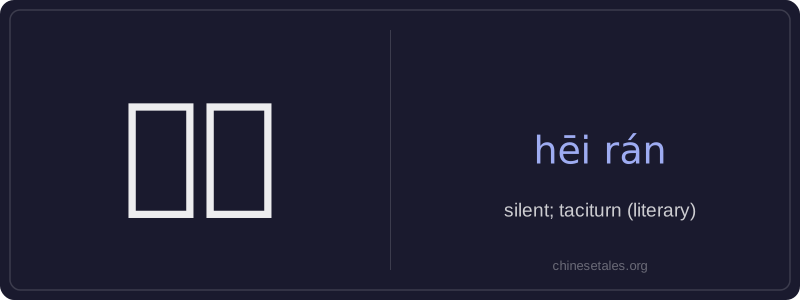
嘿然 (hēi rán) is a literary, somewhat formal adjective meaning 'silent' or 'taciturn' — describing a person who remains quiet, often deliberately or with quiet dignity, without speaking even when expected to. The first character 嘿 (hēi) originally means 'to be silent' (a variant of 默), while 然 (rán) functions as a classical suffix meaning 'in the manner of' or 'thus', turning the root into an adverbial or adjectival form. Together, they convey a state of composed, unspoken stillness — not just absence of sound, but quiet resolve or restrained emotion.
This term appears mainly in written Chinese — classical texts, modern literary prose, or formal speeches — and rarely in casual speech. It often describes someone who listens attentively without comment, endures hardship silently, or declines to argue despite provocation. Unlike the neutral 沉默 (chénmò), 嘿然 carries subtle connotations of nobility, stoicism, or quiet strength, making it especially suitable for portraying dignified restraint.
Example Sentences
Related Words
国语
‘Guó yǔ’ literally means 'national language'—
无论谁
‘无论谁’ (wú lùn shéi) is a pronoun meaning
外语
‘外语’ literally means ‘outside language’ —
不对
不对 (bù duì) literally combines 不 (bù), meani
我的
我的 (wǒ de) is a possessive pronoun meaning 'my'
违规
违规 (wéi guī) literally means 'to violate rules
亲笔
‘亲笔’ literally means ‘one’s own hand’—comb
面条
‘面条’ (miàn tiáo) literally means ‘flour str