Word Explanation
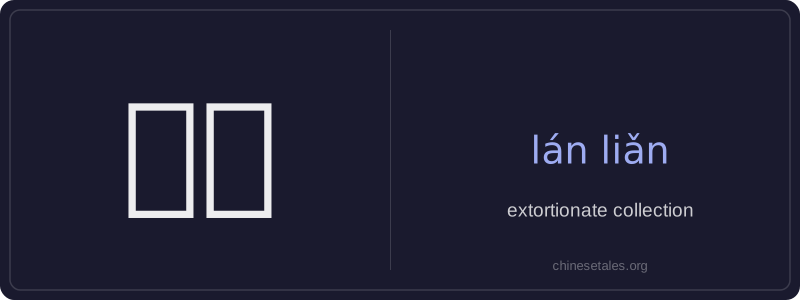
‘婪敛’ is a formal, literary noun meaning 'extortionate collection' or 'greedy, excessive seizure', often implying illegitimate or morally unjust acquisition—especially of money, resources, or power. The first character 婪 (lán) means 'greedy' or 'voracious', evoking the image of an insatiable appetite (it contains the 'animal' radical 犭, linking it to animal-like rapacity). The second character 敛 (liǎn) means 'to collect', 'to gather', or 'to levy', commonly used in contexts like tax collection or resource accumulation. Together, 婪敛 emphasizes not just collection, but collection driven by unchecked greed and abuse of authority.
This term appears primarily in classical Chinese, historical texts, political criticism, and journalistic writing condemning corruption or exploitation. It carries strong negative connotations and is rarely used in casual speech. While it can describe human behavior, its etymological connection to the animal radical reinforces associations with primal, uncontrolled desire—hence its inclusion under the 'Animals' topic as a lexical relic reflecting ancient semantic framing of greed.
Example Sentences
Related Words
国语
‘Guó yǔ’ literally means 'national language'—
无论谁
‘无论谁’ (wú lùn shéi) is a pronoun meaning
外语
‘外语’ literally means ‘outside language’ —
不对
不对 (bù duì) literally combines 不 (bù), meani
我的
我的 (wǒ de) is a possessive pronoun meaning 'my'
违规
违规 (wéi guī) literally means 'to violate rules
亲笔
‘亲笔’ literally means ‘one’s own hand’—comb
面条
‘面条’ (miàn tiáo) literally means ‘flour str