Word Explanation
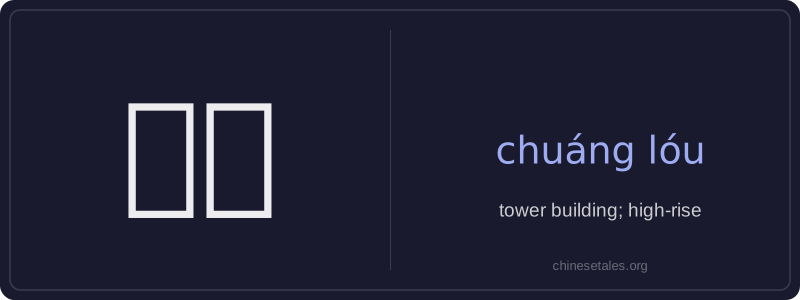
‘幢楼’ (chuáng lóu) is a compound noun meaning ‘tower building’ or ‘high-rise’, commonly used in urban contexts to refer to tall, multi-story residential or commercial buildings. The character 幢 (chuáng) is an ancient measure word for buildings—especially large, imposing structures—and carries a sense of vertical scale and architectural prominence. 楼 (lóu) means ‘building’, ‘floor’, or ‘story’, often implying multiple levels. Together, 幢楼 emphasizes the building’s height and formal presence, distinguishing it from smaller or low-rise structures like 平房 (píngfáng, bungalows) or 小楼 (xiǎo lóu, small buildings).
This term appears frequently in real estate listings, city planning documents, and everyday descriptions of modern cityscapes. It’s more formal and descriptive than generic terms like 大楼 (dà lóu, big building), and is rarely used for single-family homes or historical architecture. While 幢 can stand alone as a measure word (e.g., 一幢楼), 幢楼 functions as a fixed noun meaning a distinct high-rise unit—often implying a self-contained structure with its own entrance, elevators, and management.
Example Sentences
Related Words
国语
‘Guó yǔ’ literally means 'national language'—
无论谁
‘无论谁’ (wú lùn shéi) is a pronoun meaning
不对
不对 (bù duì) literally combines 不 (bù), meani
外语
‘外语’ literally means ‘outside language’ —
我的
我的 (wǒ de) is a possessive pronoun meaning 'my'
违规
违规 (wéi guī) literally means 'to violate rules
亲笔
‘亲笔’ literally means ‘one’s own hand’—comb
面条
‘面条’ (miàn tiáo) literally means ‘flour str