Word Explanation
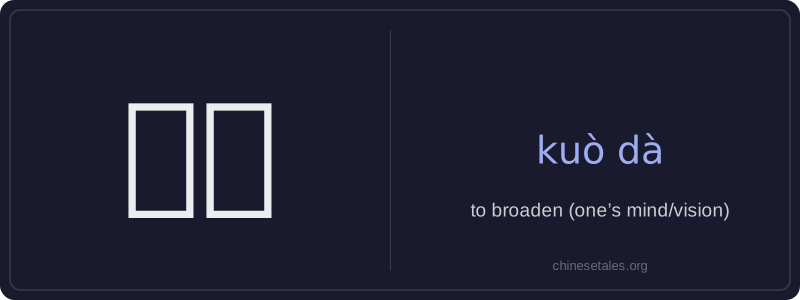
‘廓大’ is a formal, literary verb meaning 'to broaden'—especially one’s mind, vision, horizons, or understanding. The first character 廓 (kuò) originally means 'to expand the boundaries' or 'to clear away obstruction', evoking openness and spaciousness; the second character 大 (dà) means 'big' or 'great'. Together, they convey the idea of actively enlarging one’s mental or perceptual scope—not just passively growing, but deliberately removing limitations. It’s commonly used in educational, philosophical, or self-cultivation contexts, often with abstract nouns like 视野 (shìyě, 'vision'), 心胸 (xīnxiōng, 'mind and heart'), or 胸襟 (xiōngjīn, 'broad-mindedness').
While it can occasionally describe physical expansion (e.g., of space), its dominant usage is metaphorical and introspective. It carries a positive, aspirational tone—suggesting maturity, wisdom, and openness to new ideas. Learners should note that ‘廓大’ is rarely used in casual speech; it appears more often in writing, speeches, or reflective discourse than in everyday conversation.
Example Sentences
Related Words
国语
‘Guó yǔ’ literally means 'national language'—
无论谁
‘无论谁’ (wú lùn shéi) is a pronoun meaning
不对
不对 (bù duì) literally combines 不 (bù), meani
外语
‘外语’ literally means ‘outside language’ —
我的
我的 (wǒ de) is a possessive pronoun meaning 'my'
违规
违规 (wéi guī) literally means 'to violate rules
亲笔
‘亲笔’ literally means ‘one’s own hand’—comb
面条
‘面条’ (miàn tiáo) literally means ‘flour str