Word Explanation
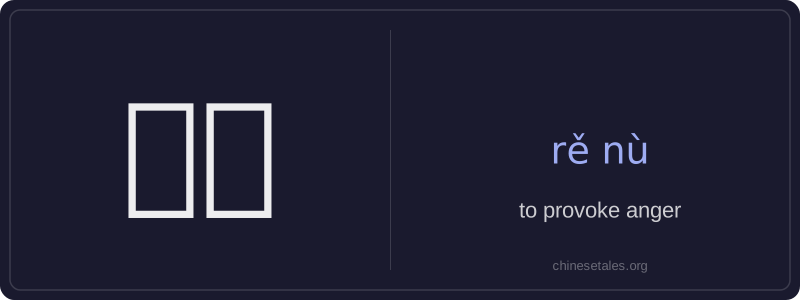
惹怒 is a transitive verb meaning 'to provoke anger' or 'to make someone angry.' It combines 惹 (rě), which means 'to provoke, to incur, or to attract (often something negative),' and 怒 (nù), meaning 'anger' or 'wrath.' Together, they form a compact, slightly formal or literary expression indicating the act of causing another person to become angry—usually unintentionally or through careless behavior. The word emphasizes causation: the subject actively triggers the emotional response in the object.
This term is commonly used in written Chinese, news reports, and formal speech, but it also appears in everyday conversation when describing interpersonal friction—especially situations involving disrespect, teasing, or boundary violations. It implies responsibility on the part of the provoker and often carries a mildly negative or critical tone. Unlike simpler verbs like 生气 (shēngqì, 'to get angry'), 惹怒 always requires an agent (the one who provokes) and a target (the one angered), making it inherently relational and action-oriented.
Example Sentences
Related Words
国语
‘Guó yǔ’ literally means 'national language'—
无论谁
‘无论谁’ (wú lùn shéi) is a pronoun meaning
不对
不对 (bù duì) literally combines 不 (bù), meani
外语
‘外语’ literally means ‘outside language’ —
违规
违规 (wéi guī) literally means 'to violate rules
我的
我的 (wǒ de) is a possessive pronoun meaning 'my'
亲笔
‘亲笔’ literally means ‘one’s own hand’—comb
面条
‘面条’ (miàn tiáo) literally means ‘flour str