Word Explanation
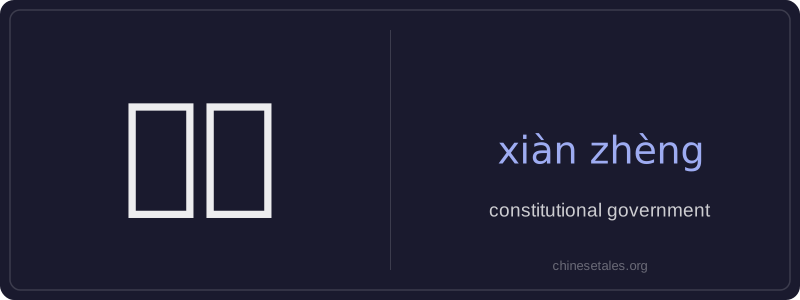
Constitutional government (xiàn zhèng) refers to a political system in which the authority of the government is derived from and limited by a constitution — a foundational legal document that defines citizens’ rights, governmental powers, and procedures for governance. The character 宪 (xiàn) means 'constitution' or 'fundamental law', while 政 (zhèng) means 'government' or 'politics'; together, they denote rule according to constitutional principles rather than arbitrary authority.
This term is commonly used in academic, legal, and political discourse in Chinese-speaking contexts, especially when discussing democratic institutions, rule of law, civil liberties, or historical reforms. It carries formal, often idealistic connotations — implying legitimacy, accountability, and protection of rights. While widely discussed in theory, its practical implementation varies across jurisdictions, and it is frequently contrasted with authoritarian or extra-legal governance models.
Example Sentences
Related Words
国语
‘Guó yǔ’ literally means 'national language'—
无论谁
‘无论谁’ (wú lùn shéi) is a pronoun meaning
不对
不对 (bù duì) literally combines 不 (bù), meani
外语
‘外语’ literally means ‘outside language’ —
违规
违规 (wéi guī) literally means 'to violate rules
我的
我的 (wǒ de) is a possessive pronoun meaning 'my'
亲笔
‘亲笔’ literally means ‘one’s own hand’—comb
面条
‘面条’ (miàn tiáo) literally means ‘flour str