Word Explanation
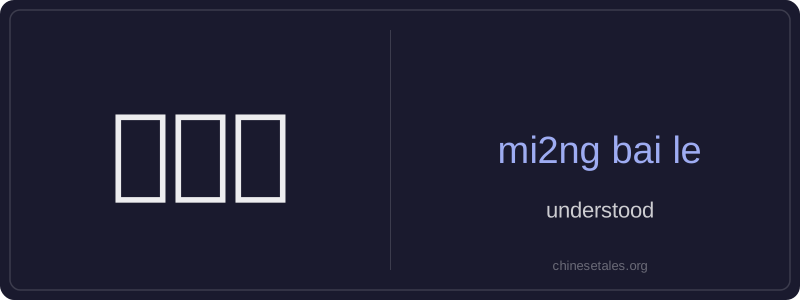
‘明白了’ (míng bai le) is a common verbal phrase meaning ‘understood’ or ‘I get it.’ It combines 明 (míng, ‘bright,’ ‘clear’) and 白 (bái, ‘white,’ ‘plain’), together forming the verb 明白 (míng bai), which literally means ‘to become clear’ — i.e., to grasp something mentally. The final particle 了 (le) signals a change of state: the speaker has just reached understanding. It’s used almost exclusively as a response to instructions, explanations, or requests — never as a standalone description of a permanent trait.
This phrase carries a polite, cooperative tone and is widely appropriate in both casual and semi-formal contexts, such as classrooms, workplaces, or daily conversations with friends or service staff. Unlike English ‘got it,’ it rarely sounds abrupt; instead, it conveys attentiveness and willingness to comply. Learners should avoid using it in written reports or formal speeches — there, more precise verbs like ‘comprehend’ or ‘acknowledge’ are preferred in English equivalents, and Chinese speakers would use phrases like ‘我已了解’ instead.
Example Sentences
Related Words
我的
我的 (wǒ de) is a possessive pronoun meaning 'my'
在家
'Zài jiā' literally combines the preposition 'z
红色的
红色的 (hóng sè de) is an adjective meaning 'red
一天
‘一天’ literally combines the numeral ‘一’ (y
不对
不对 (bù duì) literally combines 不 (bù), meani
不要
'不要' (bù yào) is a two-character verb phrase m
学校的
'学校的' is a possessive phrase meaning 'school's'
大的
大的 (dà de) is the attributive form of the adjec