Word Explanation
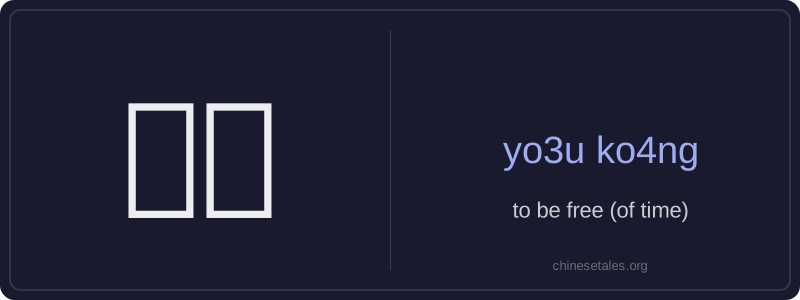
'Yǒu kòng' literally combines 'yǒu' (to have) and 'kòng' (free time, vacancy), meaning 'to be free' or 'to have time available.' It describes a person’s availability—not in the sense of physical space, but temporal openness. Unlike formal terms like 'xiá yú shí jiān,' 'yǒu kòng' is neutral to slightly informal and commonly used in everyday speech when arranging meetings, making plans, or responding to invitations.
The phrase functions as a predicate adjective or verb phrase: it usually appears after the subject and before time expressions or purpose clauses (e.g., 'wǒ míng tiān yǒu kòng'). It does not take aspect particles like 'le' or 'guo' directly—instead, you'd say 'wǒ zuó tiān méi yǒu kòng' for past negation. Note that 'kòng' alone means 'vacancy' or 'gap,' but only 'yǒu kòng' (never 'kòng' alone) expresses personal availability in spoken Mandarin.
Example Sentences
Related Words
我的
我的 (wǒ de) is a possessive pronoun meaning 'my'
在家
'Zài jiā' literally combines the preposition 'z
红色的
红色的 (hóng sè de) is an adjective meaning 'red
一天
‘一天’ literally combines the numeral ‘一’ (y
不对
不对 (bù duì) literally combines 不 (bù), meani
不要
'不要' (bù yào) is a two-character verb phrase m
学校的
'学校的' is a possessive phrase meaning 'school's'
大的
大的 (dà de) is the attributive form of the adjec