Word Explanation
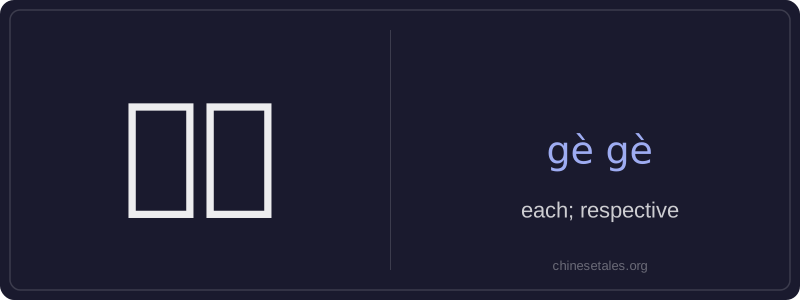
各个 means 'each' or 'respective' and functions as a distributive quantifier that emphasizes individual members within a group. Though composed of two characters—各 (gè), meaning 'each' or 'every', and 个 (gè), a common measure word—the compound 各个 is not literally 'each measure word'; instead, it has fused into a fixed expression meaning 'each one' or 'all the individual [things/people]'. It typically precedes a noun to indicate that every member of a plural or collective noun is being referred to separately.
This word is commonly used in both spoken and written Chinese, especially in formal or descriptive contexts like instructions, reports, or comparisons. It often appears before nouns denoting categories (e.g., 各个部门 'each department', 各个学校 'each school') or with pronouns (e.g., 各个都... 'each one...'). Unlike the simpler 各, which usually requires a following noun (e.g., 各国 'various countries'), 各个 can stand alone more flexibly as an adjectival or adverbial modifier.
Example Sentences
Related Words
我的
我的 (wǒ de) is a possessive pronoun meaning 'my'
中国
‘Zhōngguó’ literally means ‘Middle Kingdom’
在家
'Zài jiā' literally combines the preposition 'z
中学
'Zhōngxué' literally combines 'zhōng' (middle)
红色的
红色的 (hóng sè de) is an adjective meaning 'red
一天
‘一天’ literally combines the numeral ‘一’ (y
不对
不对 (bù duì) literally combines 不 (bù), meani
不要
'不要' (bù yào) is a two-character verb phrase m