Word Explanation
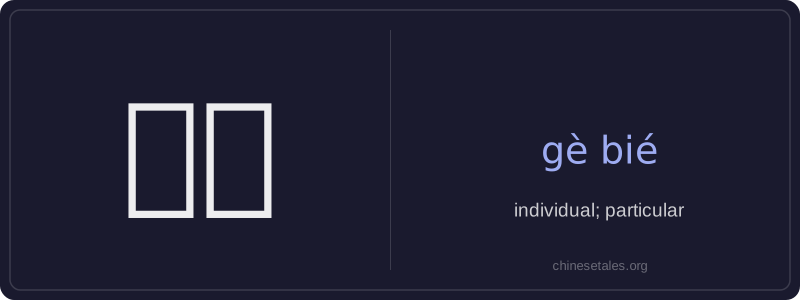
‘个别’ (gèbié) is an adjective meaning ‘individual’ or ‘particular’, used to refer to one or a few specific items, people, or cases—especially when distinguishing them from a larger group or general rule. The first character 个 (gè) is a common measure word often implying ‘a single instance’, while 别 (bié) here conveys ‘other’, ‘distinct’, or ‘separate’, together forming the idea of ‘one distinct (as opposed to collective)’. It emphasizes singularity and specificity rather than quantity.
This word frequently appears in formal or semi-formal contexts—such as education, policy, management, or daily communication—to highlight exceptions, special circumstances, or personalized treatment. It’s not used for counting (e.g., ‘three individuals’) but for qualitative distinction: e.g., ‘个别学生’ means ‘certain individual students’ (not all, but some specific ones), often implying they differ from the norm in behavior, needs, or situation.
Example Sentences
Related Words
我的
我的 (wǒ de) is a possessive pronoun meaning 'my'
中国
‘Zhōngguó’ literally means ‘Middle Kingdom’
在家
'Zài jiā' literally combines the preposition 'z
中学
'Zhōngxué' literally combines 'zhōng' (middle)
红色的
红色的 (hóng sè de) is an adjective meaning 'red
一天
‘一天’ literally combines the numeral ‘一’ (y
不对
不对 (bù duì) literally combines 不 (bù), meani
不要
'不要' (bù yào) is a two-character verb phrase m