Word Explanation
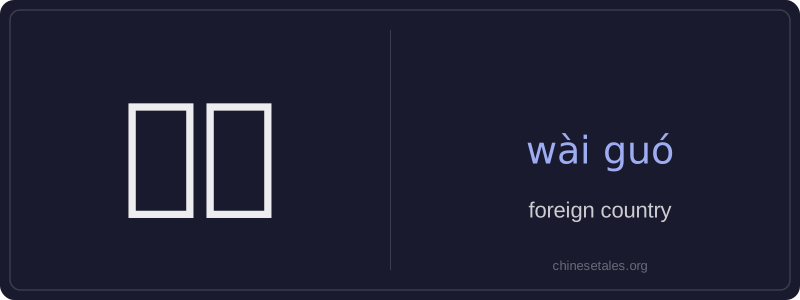
‘外国’ literally means ‘outside country’ — combining 外 (wài, ‘outside, foreign’) and 国 (guó, ‘country, nation’). It refers to any country other than China and is used exclusively as a noun. Unlike English ‘foreign,’ it cannot function as an adjective on its own; to modify a noun, you need the structure 外国的 (e.g., 外国的朋友). It’s neutral in register and commonly appears in contexts involving travel, immigration, international relations, or cultural exchange.
The term is always relative to the speaker’s national context: for a Chinese speaker, ‘外国’ means non-Chinese countries; for a Japanese speaker, it would mean non-Japanese countries. It’s distinct from more formal terms like ‘海外’ (hǎiwài, ‘overseas’) or technical terms like ‘他国’ (tāguó, ‘another country’), which sound more literary or diplomatic. In everyday speech, it’s frequently paired with words like 留学 (liúxué, ‘study abroad’), 食物 (shíwù, ‘food’), or 人 (rén, ‘person’).
Example Sentences
Related Words
我的
我的 (wǒ de) is a possessive pronoun meaning 'my'
中国
‘Zhōngguó’ literally means ‘Middle Kingdom’
在家
'Zài jiā' literally combines the preposition 'z
中学
'Zhōngxué' literally combines 'zhōng' (middle)
红色的
红色的 (hóng sè de) is an adjective meaning 'red
一天
‘一天’ literally combines the numeral ‘一’ (y
不对
不对 (bù duì) literally combines 不 (bù), meani
不要
'不要' (bù yào) is a two-character verb phrase m