Word Explanation
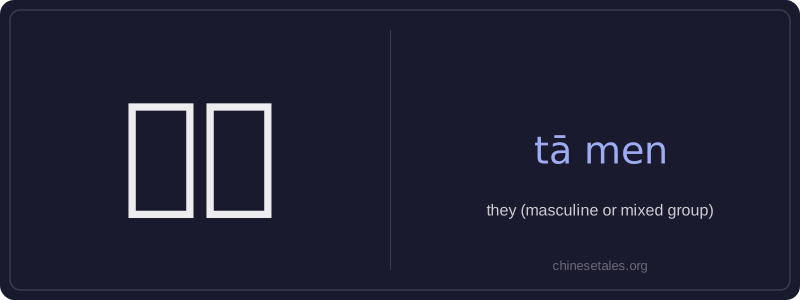
They is the third-person plural pronoun in Chinese, used to refer to a group of people (or sometimes animals) that are masculine or mixed-gender. It is formed by adding the plural suffix 们 (men) to the singular pronoun 他 (tā), meaning 'he'. Unlike English, Chinese does not distinguish gender in plural pronouns — 他们 covers both all-male and male-plus-female groups. The suffix 们 cannot be used with most other nouns (e.g., *学生们 is acceptable in informal speech but *桌子们 is ungrammatical); it’s restricted mainly to pronouns and a small set of human nouns.
This pronoun carries no honorific or formal connotation — it’s neutral and widely used in spoken and written Mandarin. Note that 他们 is never used for all-female groups; that requires 她们 (tā men). Also, 他们 can occasionally refer to animals when the context clearly personifies them (e.g., pets in stories), but this is stylistic rather than grammatical.
Example Sentences
Related Words
我的
我的 (wǒ de) is a possessive pronoun meaning 'my'
中国
‘Zhōngguó’ literally means ‘Middle Kingdom’
在家
'Zài jiā' literally combines the preposition 'z
中学
'Zhōngxué' literally combines 'zhōng' (middle)
红色的
红色的 (hóng sè de) is an adjective meaning 'red
一天
‘一天’ literally combines the numeral ‘一’ (y
不对
不对 (bù duì) literally combines 不 (bù), meani
不要
'不要' (bù yào) is a two-character verb phrase m