Word Explanation
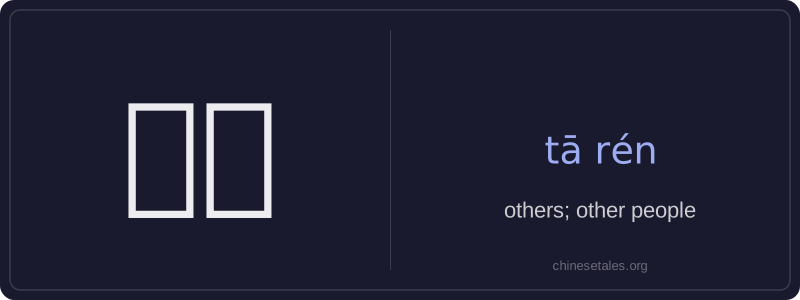
他人 means 'others' or 'other people' and functions as a collective noun referring to people besides oneself or the immediate group. It is composed of 他 (tā, 'he/they') and 人 (rén, 'person/people'), combining to emphasize people outside one's own circle — not just 'he' but 'others' in a general, often formal or reflective sense. Unlike the pronoun 他们 (tāmen, 'they'), 他人 carries a more abstract, inclusive, or even philosophical nuance, frequently appearing in discussions about social responsibility, ethics, privacy, or interpersonal boundaries.
This term is commonly used in written Chinese and formal speech — for example, in laws, moral education, or psychology — rather than casual daily talk, where speakers might prefer simpler alternatives like 别人 (biérén). It’s neutral in tone but leans slightly formal or literary, and it rarely appears in isolation; it usually modifies or follows verbs like 尊重 (zūnzhòng, 'to respect'), 考虑 (kǎolǜ, 'to consider'), or 影响 (yǐngxiǎng, 'to affect').
Example Sentences
Related Words
我的
我的 (wǒ de) is a possessive pronoun meaning 'my'
中国
‘Zhōngguó’ literally means ‘Middle Kingdom’
在家
'Zài jiā' literally combines the preposition 'z
中学
'Zhōngxué' literally combines 'zhōng' (middle)
红色的
红色的 (hóng sè de) is an adjective meaning 'red
一天
‘一天’ literally combines the numeral ‘一’ (y
不对
不对 (bù duì) literally combines 不 (bù), meani
不要
'不要' (bù yào) is a two-character verb phrase m