Word Explanation
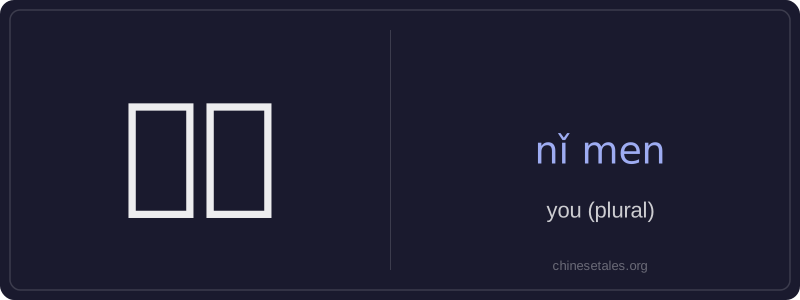
'Nǐ men' is the standard plural form of the second-person pronoun 'you' in Mandarin Chinese. It consists of the singular pronoun 你 (nǐ, 'you') combined with the plural suffix 们 (men), which attaches only to pronouns—not nouns—to indicate 'more than one person.' Unlike English, Chinese does not distinguish formal and informal 'you' in everyday speech, so 你们 serves both casual and neutral contexts when addressing two or more people.
This pronoun is used widely in daily interactions: greetings, questions, instructions, and invitations. It appears in subject position (e.g., '你们去哪?'), object position (e.g., '我等你们'), and after prepositions (e.g., '跟你们一起'). Note that 们 cannot be used with numbers or demonstratives—so '你们三个' is correct, but '*你们这些' is ungrammatical without a noun (e.g., '你们这些人'). Also, 们 is never used for animals or inanimate objects.
Example Sentences
Related Words
我的
我的 (wǒ de) is a possessive pronoun meaning 'my'
中国
‘Zhōngguó’ literally means ‘Middle Kingdom’
一天
‘一天’ literally combines the numeral ‘一’ (y
在家
'Zài jiā' literally combines the preposition 'z
不要
'不要' (bù yào) is a two-character verb phrase m
这边
这边 (zhè biān) literally combines 这 (zhè, 'th
这么
这么 (zhè me) is an adverb meaning 'so' or 'this
中学
'Zhōngxué' literally combines 'zhōng' (middle)