Word Explanation
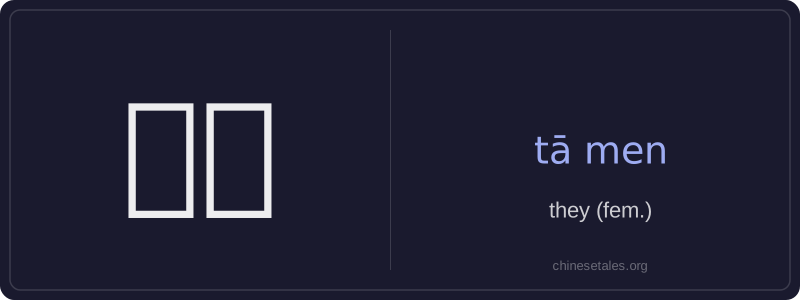
'Tāmen' is the third-person plural pronoun meaning 'they' when referring exclusively to a group of females or mixed-gender groups where the speaker emphasizes the feminine identity of the referents. It is formed by adding the plural suffix 们 (men) to the singular feminine pronoun 她 (tā). Unlike English, Chinese pronouns do not change form for subject/object case — 她们 functions identically whether it's the subject ('They went home') or object ('I saw them').
This pronoun is used only for animate referents — never for animals, objects, or abstract concepts. It carries no grammatical gender marking beyond the base character 她, so context or prior mention is essential to confirm the referent is female or predominantly female. In spoken Mandarin, the tone on 们 is neutral (light), and it cannot stand alone — it must always follow a personal pronoun or certain kinship terms (e.g., 妈妈们).
Example Sentences
Related Words
我的
我的 (wǒ de) is a possessive pronoun meaning 'my'
中国
‘Zhōngguó’ literally means ‘Middle Kingdom’
一天
‘一天’ literally combines the numeral ‘一’ (y
在家
'Zài jiā' literally combines the preposition 'z
不要
'不要' (bù yào) is a two-character verb phrase m
这边
这边 (zhè biān) literally combines 这 (zhè, 'th
这么
这么 (zhè me) is an adverb meaning 'so' or 'this
中学
'Zhōngxué' literally combines 'zhōng' (middle)