Word Explanation
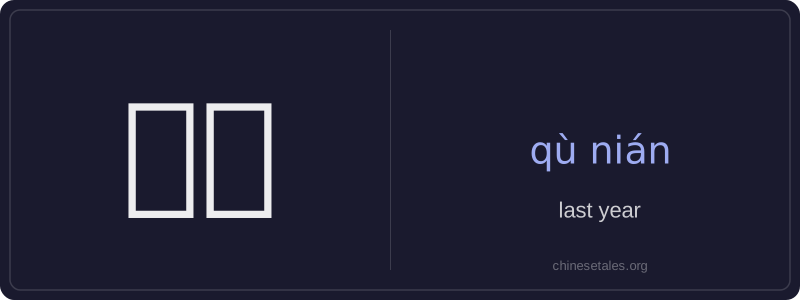
'去年' (qù nián) literally combines '去' (qù), meaning 'to go' or 'past', and '年' (nián), meaning 'year'. Together, they form a fixed noun phrase meaning 'last year' — the calendar year immediately before the current one. It functions as a temporal noun and typically appears at the beginning or end of a sentence to anchor an action or event in time.
This term is neutral in register and widely used in both spoken and written Chinese. Unlike English, where 'last year' can sometimes imply 'a year ago' in relative terms, '去年' always refers strictly to the previous calendar year — for example, if today is March 2024, '去年' means all of 2023. It does not require measure words or particles like '的' when used attributively (e.g., '去年的冬天'), but it cannot stand alone as a verb or adjective.
Example Sentences
Related Words
我的
我的 (wǒ de) is a possessive pronoun meaning 'my'
中国
‘Zhōngguó’ literally means ‘Middle Kingdom’
学校的
'学校的' is a possessive phrase meaning 'school's'
一天
‘一天’ literally combines the numeral ‘一’ (y
在家
'Zài jiā' literally combines the preposition 'z
不要
'不要' (bù yào) is a two-character verb phrase m
这边
这边 (zhè biān) literally combines 这 (zhè, 'th
这么
这么 (zhè me) is an adverb meaning 'so' or 'this