Word Explanation
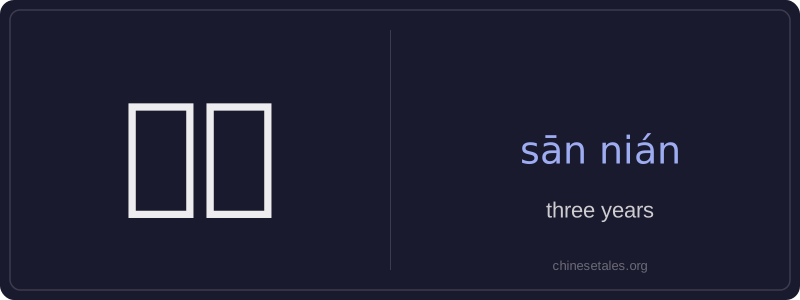
'Three years' is a compound numeral-noun phrase formed by the numeral 三 (sān, 'three') followed by the noun 年 (nián, 'year'). Unlike English, Chinese does not use plural markers — 年 remains unchanged regardless of quantity. This phrase functions as a time duration and commonly appears after measure words like 'for' (e.g., 在...里, 已经), or with verbs indicating duration such as 住 (live), 学习 (study), or 工作 (work). It can also serve as a subject or object in sentences.
The phrase is neutral in register and widely used in both spoken and written Chinese — from casual conversation ('我在这里住了三年') to formal contexts ('该项目已运行三年'). It frequently pairs with time-related adverbs like 已经 (already), 还要 (still need to), or 刚刚 (just), and often implies continuity or completion depending on context and aspect particles like 了 or 过.
Example Sentences
Related Words
我的
我的 (wǒ de) is a possessive pronoun meaning 'my'
中国
‘Zhōngguó’ literally means ‘Middle Kingdom’
学校的
'学校的' is a possessive phrase meaning 'school's'
一天
‘一天’ literally combines the numeral ‘一’ (y
在家
'Zài jiā' literally combines the preposition 'z
不对
不对 (bù duì) literally combines 不 (bù), meani
不要
'不要' (bù yào) is a two-character verb phrase m
这边
这边 (zhè biān) literally combines 这 (zhè, 'th