Word Explanation
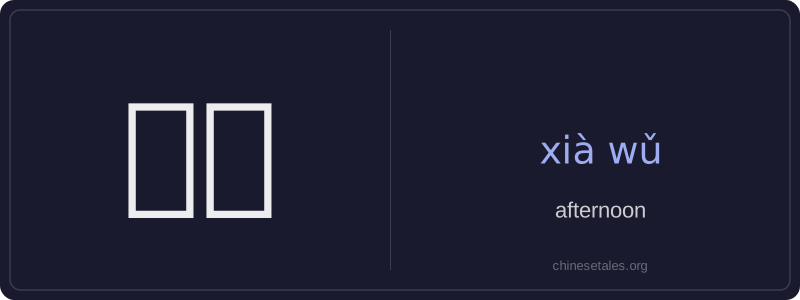
'下午' literally combines '下' (xià), meaning 'below' or 'after', and '午' (wǔ), which originally refers to the midday hour (11 a.m.–1 p.m.) in traditional Chinese timekeeping. Together, they denote the period after noon — specifically from 12:00 p.m. onward — and are used broadly for the entire afternoon, typically up to around 6:00 p.m. Unlike English, Chinese doesn’t usually specify 'early' or 'late' afternoon unless needed; '下午' alone suffices for general reference.
This term functions as a temporal noun and commonly appears at the beginning or end of sentences to indicate when something happens. It’s neutral in register — appropriate in both casual speech and formal writing — and frequently pairs with time words like '三点' (3 p.m.), '两点' (2 p.m.), or verbs like '工作' (work), '休息' (rest), or '开会' (have a meeting). It never stands alone as a complete time expression without context — e.g., you’d say '下午三点' not just '下午' to mean '3 p.m.'
Example Sentences
Related Words
我的
我的 (wǒ de) is a possessive pronoun meaning 'my'
中国
‘Zhōngguó’ literally means ‘Middle Kingdom’
不对
不对 (bù duì) literally combines 不 (bù), meani
红色的
红色的 (hóng sè de) is an adjective meaning 'red
学校的
'学校的' is a possessive phrase meaning 'school's'
一天
‘一天’ literally combines the numeral ‘一’ (y
在家
'Zài jiā' literally combines the preposition 'z
不要
'不要' (bù yào) is a two-character verb phrase m