Word Explanation
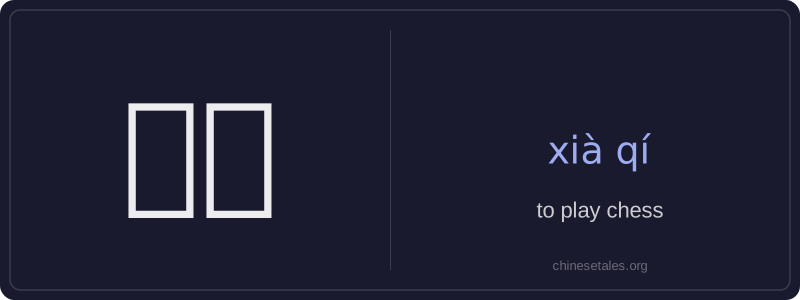
'Xià qí' literally means 'to go down chess pieces' — 'xià' (down/put/place) and 'qí' (chess or board game). Together, they form a verb meaning 'to play chess', referring specifically to the traditional Chinese game of Xiangqi (Chinese chess) or sometimes Go (Weiqi), though context usually clarifies which. It’s a common daily activity among adults and elders in parks, homes, and community centers, often associated with leisure, strategy, and social bonding.
The phrase is always used as a verb and requires no object when the type of chess is understood; if specifying, you add a modifier like 'xià xiàngqí' (play Chinese chess) or 'xià wéiqí' (play Go). It cannot be used as a noun — you wouldn’t say 'a xià qí'; instead, use 'yì jú qí' (a game of chess). The action implies turn-based, rule-bound play between two people, emphasizing thoughtfulness and patience.
Example Sentences
Related Words
我的
我的 (wǒ de) is a possessive pronoun meaning 'my'
中国
‘Zhōngguó’ literally means ‘Middle Kingdom’
不对
不对 (bù duì) literally combines 不 (bù), meani
红色的
红色的 (hóng sè de) is an adjective meaning 'red
学校的
'学校的' is a possessive phrase meaning 'school's'
一天
‘一天’ literally combines the numeral ‘一’ (y
在家
'Zài jiā' literally combines the preposition 'z
不要
'不要' (bù yào) is a two-character verb phrase m