Word Explanation
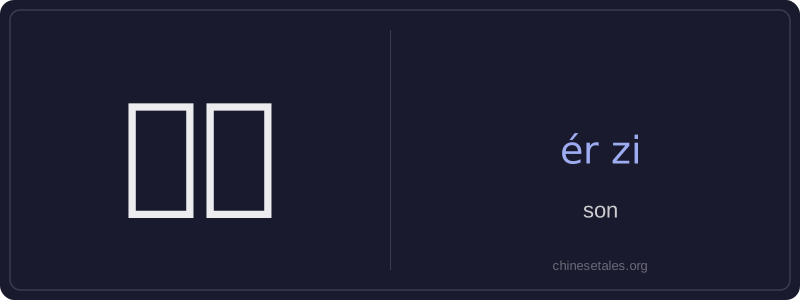
‘儿子’ (ér zi) means ‘son’ — a male child in relation to his parents. The first character 儿 (ér) originally meant ‘child’ or ‘young person’ and often appears in kinship terms (e.g., 儿女 ér nǚ ‘children’); the second character 子 (zi) is a common noun suffix meaning ‘child’ or ‘offspring’, and it’s also used independently to mean ‘child’ or ‘son’. Together, 儿子 specifically denotes a male offspring and is neutral in register — appropriate for formal documents, everyday speech, and family contexts.
This term is used when identifying or referring to one’s own son, someone else’s son, or in general discussions about family structure. Unlike some kinship terms that change based on speaker relationship (e.g., 爸爸 vs. 令尊), 儿子 remains the same regardless of who is speaking or being addressed. It’s frequently paired with possessive pronouns (e.g., 我的儿子 wǒ de érzi ‘my son’) or numbers (e.g., 大儿子 dà érzi ‘eldest son’).
Example Sentences
Related Words
我的
我的 (wǒ de) is a possessive pronoun meaning 'my'
中国
‘Zhōngguó’ literally means ‘Middle Kingdom’
不对
不对 (bù duì) literally combines 不 (bù), meani
红色的
红色的 (hóng sè de) is an adjective meaning 'red
学校的
'学校的' is a possessive phrase meaning 'school's'
一天
‘一天’ literally combines the numeral ‘一’ (y
在家
'Zài jiā' literally combines the preposition 'z
不要
'不要' (bù yào) is a two-character verb phrase m