Word Explanation
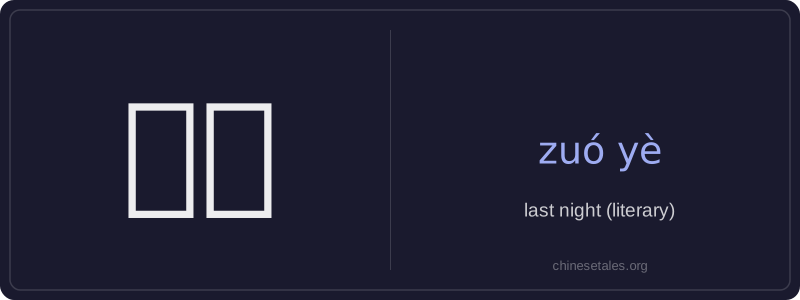
‘昨夜’ literally combines ‘昨’ (zuó), meaning ‘yesterday’, and ‘夜’ (yè), meaning ‘night’. Together, they form the compound noun ‘last night’. While functionally equivalent to the more common spoken phrase ‘昨晚’ (zuó wǎn), ‘昨夜’ carries a slightly more literary, poetic, or formal register — it appears frequently in classical poetry, modern literary prose, song lyrics, and formal writing, but is rare in casual daily speech.
The word functions as a temporal noun, typically appearing at the beginning or end of a sentence to indicate when an action occurred. It does not require additional particles like ‘的’ or ‘了’ to mark time, though aspect markers may follow the verb. Because of its stylistic weight, learners should avoid using ‘昨夜’ in informal chats or text messages unless aiming for deliberate elegance or rhetorical effect.
Example Sentences
Related Words
见面
见面 literally means 'see face' — combining 见 (t
后来
Later (hòulái) is an adverb meaning 'afterwards'
背后
背后 literally means 'back + behind' and functions
我的
我的 (wǒ de) is a possessive pronoun meaning 'my'
这么
这么 (zhè me) is an adverb meaning 'so' or 'this
中学
'Zhōngxué' literally combines 'zhōng' (middle)
前面
前面 (qián miàn) literally combines 前 (qián, '
面条
‘面条’ (miàn tiáo) literally means ‘flour str