Word Explanation
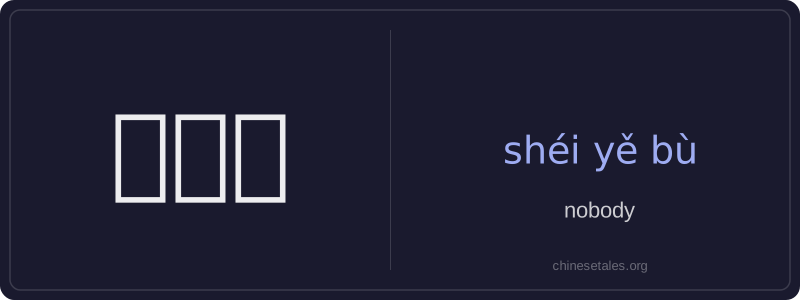
'谁也不' is a compound pronoun meaning 'nobody' or 'not anyone'. It combines the interrogative pronoun 谁 ('who'), the emphatic particle 也 ('also, even'), and the negator 不 ('not'). Together, they form a strong negative universal quantifier—literally 'not even who', i.e., no person at all. It functions as a subject or object and always appears before a verb, never alone.
This expression is common in spoken and written Mandarin to stress complete absence of people involved in an action. It carries a tone of universality and finality—more emphatic than just 没人. It’s frequently used in contexts involving inability, refusal, knowledge, or participation (e.g., 'nobody knows', 'nobody agrees'). Unlike English 'nobody', 谁也不 must be followed directly by a verb or adjective; it cannot stand alone as a noun phrase without a predicate.
Example Sentences
Related Words
见面
见面 literally means 'see face' — combining 见 (t
后来
Later (hòulái) is an adverb meaning 'afterwards'
背后
背后 literally means 'back + behind' and functions
我的
我的 (wǒ de) is a possessive pronoun meaning 'my'
这么
这么 (zhè me) is an adverb meaning 'so' or 'this
中学
'Zhōngxué' literally combines 'zhōng' (middle)
前面
前面 (qián miàn) literally combines 前 (qián, '
面条
‘面条’ (miàn tiáo) literally means ‘flour str