Word Explanation
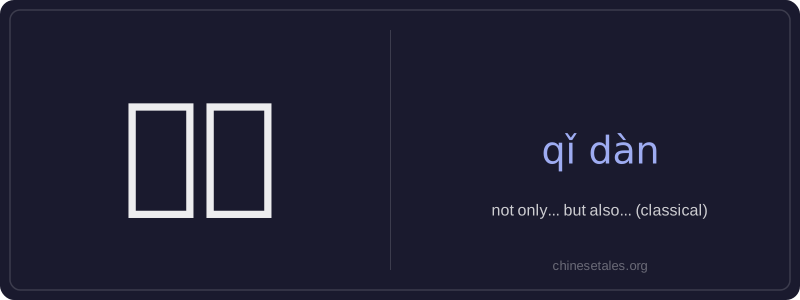
岂但 is a classical Chinese conjunction meaning 'not only... but also...' — it introduces a contrast that emphasizes an even stronger or more surprising fact beyond what was already stated. The character 岂 (qǐ) is a rhetorical question particle meaning 'how could it be that...?' or 'surely not...', expressing doubt or incredulity, while 但 (dàn) means 'but' or 'only'. Together, 岂但 negates the limitation implied by 'only', thereby affirming both the initial clause and an additional, often more significant, one. It carries formal, literary, or rhetorical weight and appears frequently in essays, speeches, historical texts, and formal writing.
This expression is not used in casual speech or modern colloquial contexts. It typically follows a negative or rhetorical structure (e.g., 岂但...,且... / 岂但...,更...) and requires parallel grammatical structures before and after. Learners should note that it is functionally equivalent to modern 不仅...而且..., but with elevated register and stylistic emphasis on logical escalation or moral/ideological force.
Example Sentences
Related Words
见面
见面 literally means 'see face' — combining 见 (t
背后
背后 literally means 'back + behind' and functions
中学
'Zhōngxué' literally combines 'zhōng' (middle)
面条
‘面条’ (miàn tiáo) literally means ‘flour str
后来
Later (hòulái) is an adverb meaning 'afterwards'
我的
我的 (wǒ de) is a possessive pronoun meaning 'my'
这么
这么 (zhè me) is an adverb meaning 'so' or 'this
前面
前面 (qián miàn) literally combines 前 (qián, '