Word Explanation
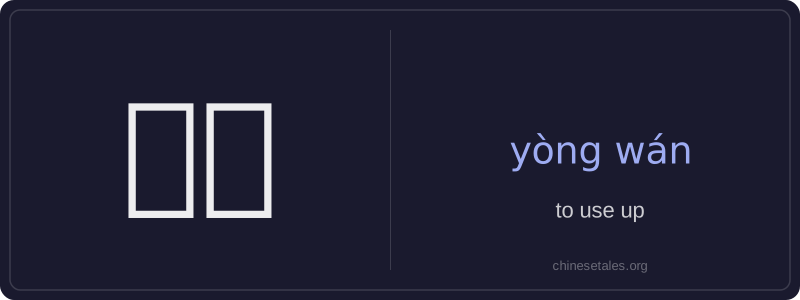
'用完' (yòng wán) is a verb meaning 'to use up' or 'to finish using' something completely — leaving none remaining. It combines the verb 用 (yòng, 'to use') with the resultative complement 完 (wán, 'to finish, to complete'), indicating that an action has reached its natural endpoint. This structure follows the common Chinese pattern Verb + 完, where 完 emphasizes completion and exhaustiveness.
The word is frequently used in everyday situations involving consumable resources: food, money, time, batteries, data plans, or office supplies. It carries a neutral-to-slightly-negative nuance when implying scarcity or unintended depletion (e.g., 'I used up all the milk'). Unlike standalone verbs like 吃光 (chī guāng, 'to eat up'), 用完 is broader and applies to any object that can be consumed or expended through use. It typically appears before an object (e.g., 用完水) or with a pronoun/demonstrative (e.g., 把它用完了).
Example Sentences
Related Words
见面
见面 literally means 'see face' — combining 见 (t
背后
背后 literally means 'back + behind' and functions
中学
'Zhōngxué' literally combines 'zhōng' (middle)
面条
‘面条’ (miàn tiáo) literally means ‘flour str
后来
Later (hòulái) is an adverb meaning 'afterwards'
我的
我的 (wǒ de) is a possessive pronoun meaning 'my'
这么
这么 (zhè me) is an adverb meaning 'so' or 'this
前面
前面 (qián miàn) literally combines 前 (qián, '