Word Explanation
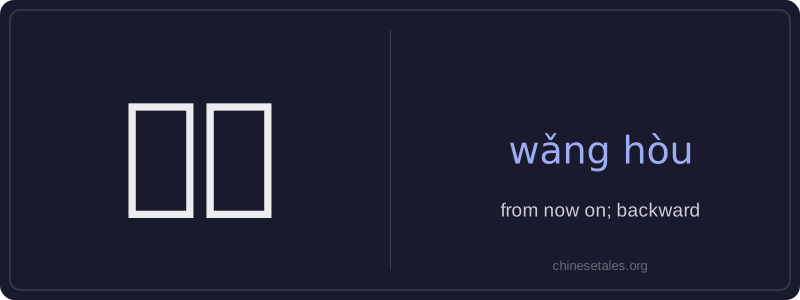
‘往后’ is an adverb meaning 'from now on' or 'in the future', emphasizing time moving forward from the present moment. It literally combines 往 (wǎng, 'toward') and 后 (hòu, 'behind' or 'after'), so together it conveys the idea of 'toward what comes after' — i.e., the future. It is commonly used in both spoken and written Chinese to mark a temporal boundary starting now and extending onward.
Unlike ‘以后’ (yǐhòu), which can refer to any point after a specified time (e.g., 'after the meeting'), ‘往后’ almost always anchors to the present unless explicitly modified (e.g., ‘从今天往后’). It carries a slightly formal or reflective tone and often appears in advice, resolutions, or summaries — for instance, when someone resolves to change a habit or looks ahead in planning. It does not mean 'backward' in physical space; that sense belongs to ‘向后’ or ‘往后退’.
Example Sentences
Related Words
见面
见面 literally means 'see face' — combining 见 (t
背后
背后 literally means 'back + behind' and functions
中学
'Zhōngxué' literally combines 'zhōng' (middle)
面条
‘面条’ (miàn tiáo) literally means ‘flour str
后来
Later (hòulái) is an adverb meaning 'afterwards'
我的
我的 (wǒ de) is a possessive pronoun meaning 'my'
这么
这么 (zhè me) is an adverb meaning 'so' or 'this
前面
前面 (qián miàn) literally combines 前 (qián, '