Word Explanation
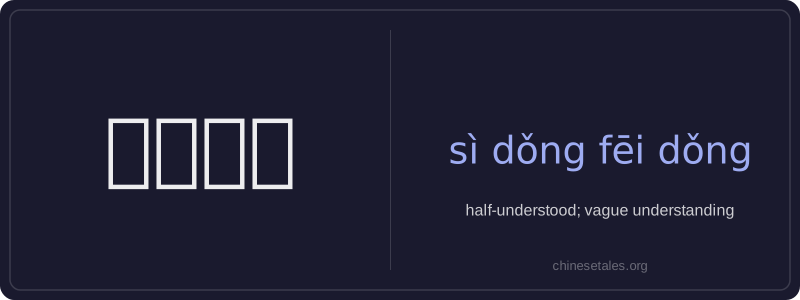
'Sì dǒng fēi dǒng' literally means 'seems to understand, yet does not understand' — a four-character idiom that vividly captures the feeling of having only a vague, incomplete, or superficial grasp of something. The structure hinges on contrast: 似 (‘seems like’) and 非 (‘not’) frame the repeated 懂 (‘to understand’), creating a rhythmic, self-reflective tension. It describes a mental state where one recognizes fragments of meaning but lacks full clarity or confidence — common when encountering complex explanations, technical jargon, or subtle cultural references.
This expression is used almost exclusively as a predicate adjective (e.g., after 是 or 很) or in descriptive clauses. It carries a mild tone of humility or gentle self-mockery, not confusion or ignorance per se, but rather the liminal space between recognition and comprehension. Native speakers often use it to soften admissions of uncertainty, especially in academic, professional, or language-learning contexts.
Example Sentences
Related Words
见面
见面 literally means 'see face' — combining 见 (t
背后
背后 literally means 'back + behind' and functions
中学
'Zhōngxué' literally combines 'zhōng' (middle)
面条
‘面条’ (miàn tiáo) literally means ‘flour str
后来
Later (hòulái) is an adverb meaning 'afterwards'
我的
我的 (wǒ de) is a possessive pronoun meaning 'my'
这么
这么 (zhè me) is an adverb meaning 'so' or 'this
前面
前面 (qián miàn) literally combines 前 (qián, '