Word Explanation
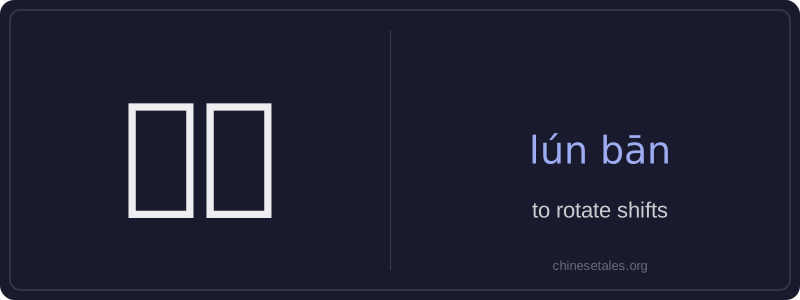
‘轮班’ (lún bān) literally combines 轮 (lún), meaning 'to rotate' or 'to take turns', and 班 (bān), meaning 'shift' or 'work shift'. Together, it describes the practice of workers taking turns performing duties at different times—common in hospitals, factories, security, and customer service where 24/7 coverage is needed. It emphasizes systematic alternation rather than random or ad-hoc scheduling.
This term is used both as a verb ('to rotate shifts') and as a noun ('shift rotation'). As a verb, it often appears with auxiliary verbs like ‘要’ (yào), ‘需要’ (xūyào), or ‘实行’ (shíxíng). As a noun, it frequently appears in phrases like ‘轮班制’ (lún bān zhì, 'rotating shift system') or ‘轮班工作’ (lún bān gōngzuò, 'shift work'). It implies fairness, continuity, and shared responsibility among team members.
Example Sentences
Related Words
见面
见面 literally means 'see face' — combining 见 (t
背后
背后 literally means 'back + behind' and functions
我的
我的 (wǒ de) is a possessive pronoun meaning 'my'
中学
'Zhōngxué' literally combines 'zhōng' (middle)
面条
‘面条’ (miàn tiáo) literally means ‘flour str
后来
Later (hòulái) is an adverb meaning 'afterwards'
在家
'Zài jiā' literally combines the preposition 'z
不对
不对 (bù duì) literally combines 不 (bù), meani