Word Explanation
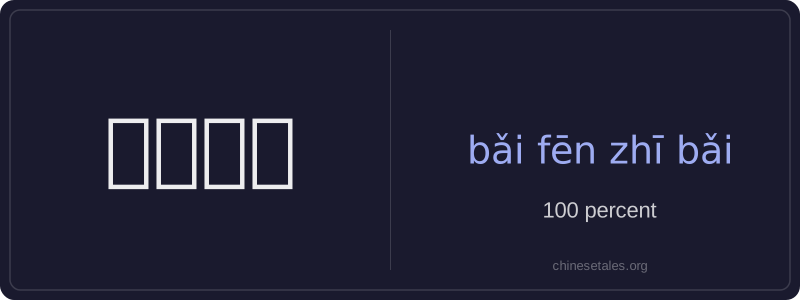
百分之百 literally means 'hundred parts of a hundred' — it’s a fixed phrase expressing complete certainty, totality, or exactness. The structure follows classical Chinese grammar: 百 (hundred) + 分 (part/division) + 之 (of) + 百 (hundred), forming a fractional expression equivalent to 100/100. It functions as both a noun ('100 percent') and an adverb ('completely', 'entirely'), often emphasizing absoluteness in statements about success, accuracy, agreement, or confidence.
This phrase is widely used in formal and informal contexts — from business reports ('the project succeeded百分之百') to everyday speech ('I’m百分之百 sure'). Unlike the English '100 percent', it rarely appears with numerals (e.g., you wouldn’t say '95百分之百'); instead, it stands alone to convey fullness. It carries a slightly emphatic or even rhetorical tone, especially when used adverbially to stress unwavering conviction or flawless execution.
Example Sentences
Related Words
见面
见面 literally means 'see face' — combining 见 (t
背后
背后 literally means 'back + behind' and functions
我的
我的 (wǒ de) is a possessive pronoun meaning 'my'
中学
'Zhōngxué' literally combines 'zhōng' (middle)
面条
‘面条’ (miàn tiáo) literally means ‘flour str
后来
Later (hòulái) is an adverb meaning 'afterwards'
在家
'Zài jiā' literally combines the preposition 'z
不对
不对 (bù duì) literally combines 不 (bù), meani