Word Explanation
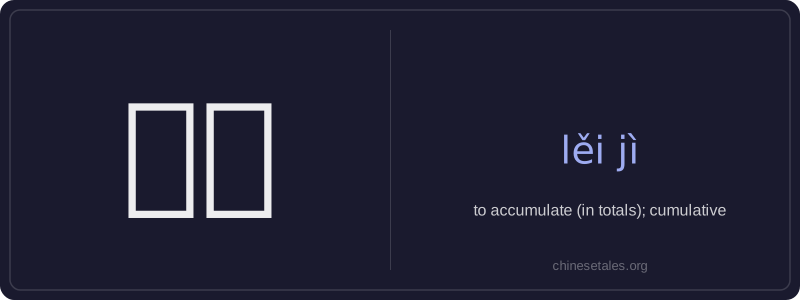
累计 (lěi jì) means 'to accumulate (in totals)' or 'cumulative'—it emphasizes the gradual addition of quantities over time or across instances, resulting in a final sum. The character 累 (lěi) conveys 'to pile up' or 'accumulate', while 计 (jì) means 'to calculate' or 'to count'. Together, they form a compound that highlights both the process of adding and the resulting total figure. It is commonly used in formal, statistical, or administrative contexts—such as reporting sales, attendance, rainfall, or cases—and often appears with measure words or time phrases (e.g., '截至...累计').
Unlike simple verbs like 加 (jiā, 'to add'), 累计 implies continuity and aggregation across multiple points, not just a one-time addition. It can function as a verb ('has accumulated') or an adjective ('cumulative number'), and frequently modifies nouns (e.g., 累计人数, 'cumulative number of people'). It’s neutral in register but more frequent in written than spoken Chinese, especially in news reports, official documents, and data summaries.
Example Sentences
Related Words
见面
见面 literally means 'see face' — combining 见 (t
背后
背后 literally means 'back + behind' and functions
我的
我的 (wǒ de) is a possessive pronoun meaning 'my'
中学
'Zhōngxué' literally combines 'zhōng' (middle)
面条
‘面条’ (miàn tiáo) literally means ‘flour str
后来
Later (hòulái) is an adverb meaning 'afterwards'
在家
'Zài jiā' literally combines the preposition 'z
不对
不对 (bù duì) literally combines 不 (bù), meani