Word Explanation
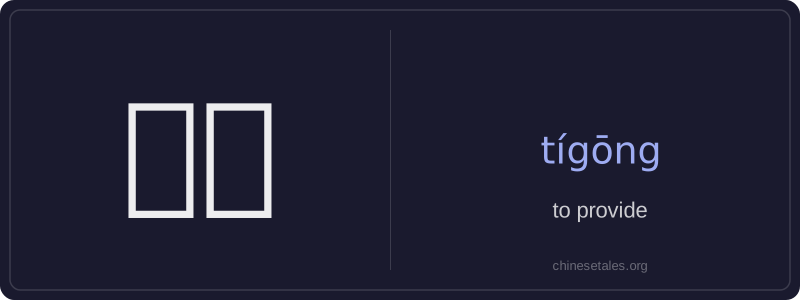
'提供' (tígōng) is a transitive verb meaning 'to provide' or 'to supply' — to make something available to someone for use, support, or benefit. The first character 提 (tí) means 'to lift, raise, or bring forth', suggesting the act of bringing something forward; the second character 供 (gōng) means 'to supply, furnish, or serve', often used in formal or institutional contexts. Together, they convey the idea of actively offering or delivering resources, services, information, or assistance.
This word is commonly used in formal, written, and professional settings — such as business, education, government, and media — rather than casual speech (where words like 给 or 拿出 are more frequent). It typically follows the pattern 'subject + 提供 + object (+ 给 + recipient)', and the object is usually concrete (e.g., food, data, support) or abstract (e.g., opportunities, information, solutions). It pairs naturally with nouns like 服务 (services), 资料 (materials), or 帮助 (help).
Example Sentences
Related Words
见面
见面 literally means 'see face' — combining 见 (t
背后
背后 literally means 'back + behind' and functions
我的
我的 (wǒ de) is a possessive pronoun meaning 'my'
中学
'Zhōngxué' literally combines 'zhōng' (middle)
面条
‘面条’ (miàn tiáo) literally means ‘flour str
后来
Later (hòulái) is an adverb meaning 'afterwards'
在家
'Zài jiā' literally combines the preposition 'z
不对
不对 (bù duì) literally combines 不 (bù), meani