Word Explanation
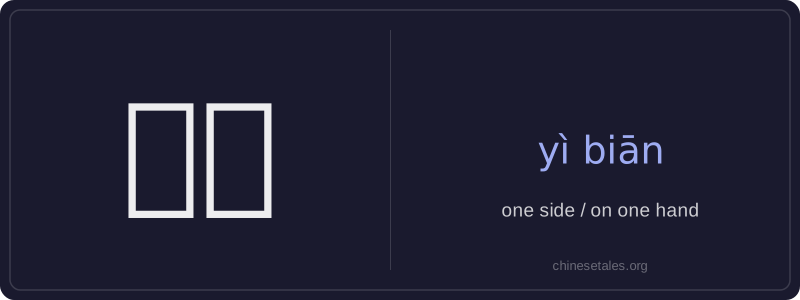
'一边' literally combines '一 (yī)' meaning 'one' and '边 (biān)' meaning 'side' or 'edge', forming a compound that denotes a physical side ('one side') or a conceptual position ('on one hand'). As a noun, it refers to a spatial location — for example, the left or right side of an object, a bank of a river, or a particular area in a room. It’s frequently used in directional or locative expressions like '桌子的一边' (one side of the table).
As an adverb, '一边' appears in the common correlative structure '一边…一边…', meaning 'while... at the same time...' — e.g., '他一边吃饭一边看书' (He reads while eating). Though this adverbial usage is extremely frequent, the core noun sense remains foundational: the 'side' metaphor extends to parallel actions occurring 'on one side' of attention or time. Note that '一边' never stands alone as a subject or object without modification — it always requires a noun phrase (e.g., '河的一边') or functions within a fixed pattern.
Example Sentences
Related Words
见面
见面 literally means 'see face' — combining 见 (t
背后
背后 literally means 'back + behind' and functions
我的
我的 (wǒ de) is a possessive pronoun meaning 'my'
中学
'Zhōngxué' literally combines 'zhōng' (middle)
面条
‘面条’ (miàn tiáo) literally means ‘flour str
后来
Later (hòulái) is an adverb meaning 'afterwards'
在家
'Zài jiā' literally combines the preposition 'z
不对
不对 (bù duì) literally combines 不 (bù), meani