Word Explanation
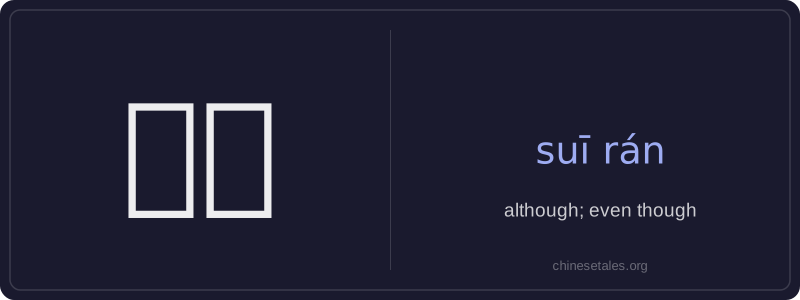
Although is a conjunction used to introduce a contrasting or concessive clause — it signals that the statement following it is true *despite* the fact stated in the main clause. The character 虽 (suī) originally meant 'although' or 'even if', and 然 (rán) means 'thus' or 'so'; together, they form a fixed two-character conjunction expressing concession. Unlike English, where 'although' can appear at the beginning or middle of a sentence, 虽然 in Chinese *must* be paired with 但是 (dànshì), 可是 (kěshì), or 不过 (bùguò) in the main clause to complete the contrast — it cannot stand alone.
This word is common in both spoken and written Mandarin, especially in formal explanations, personal reflections, or logical reasoning. It’s neutral in register and appropriate for learners at all levels. Because it introduces a subordinate clause, the clause with 虽然 usually comes first — similar to English — but the contrast marker must follow in the next clause to make the sentence grammatically complete and natural.
Example Sentences
Related Words
见面
见面 literally means 'see face' — combining 见 (t
背后
背后 literally means 'back + behind' and functions
我的
我的 (wǒ de) is a possessive pronoun meaning 'my'
中学
'Zhōngxué' literally combines 'zhōng' (middle)
面条
‘面条’ (miàn tiáo) literally means ‘flour str
后来
Later (hòulái) is an adverb meaning 'afterwards'
在家
'Zài jiā' literally combines the preposition 'z
不对
不对 (bù duì) literally combines 不 (bù), meani