Word Explanation
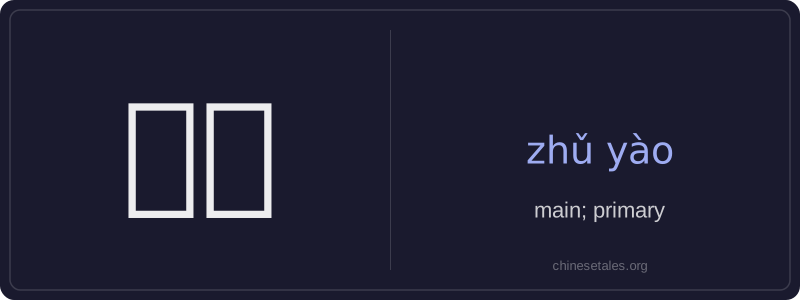
‘主要’ (zhǔ yào) is an adjective meaning ‘main’ or ‘primary’, used to indicate the most important, central, or dominant element in a group, process, or situation. The first character 主 (zhǔ) means ‘master’, ‘host’, or ‘principal’; the second character 要 (yào) means ‘essential’, ‘necessary’, or ‘crucial’. Together, they reinforce the idea of something that holds the highest priority or significance—like the main point in an argument, the primary cause of a problem, or the leading ingredient in a recipe.
This word commonly modifies nouns directly (e.g., 主要原因, 主要任务, 主要内容) and often appears before classifiers or in subject–predicate structures. It’s neutral in register—used equally in spoken and written Chinese—and frequently appears in academic, professional, and everyday contexts. Unlike some adjectives, it doesn’t change form for degree or comparison and is rarely used predicatively without additional structure (e.g., not *‘这个很主要’ — instead say ‘这个是主要的’ or ‘这个很重要’).
Example Sentences
Related Words
见面
见面 literally means 'see face' — combining 见 (t
背后
背后 literally means 'back + behind' and functions
我的
我的 (wǒ de) is a possessive pronoun meaning 'my'
中学
'Zhōngxué' literally combines 'zhōng' (middle)
面条
‘面条’ (miàn tiáo) literally means ‘flour str
后来
Later (hòulái) is an adverb meaning 'afterwards'
在家
'Zài jiā' literally combines the preposition 'z
不对
不对 (bù duì) literally combines 不 (bù), meani