Word Explanation
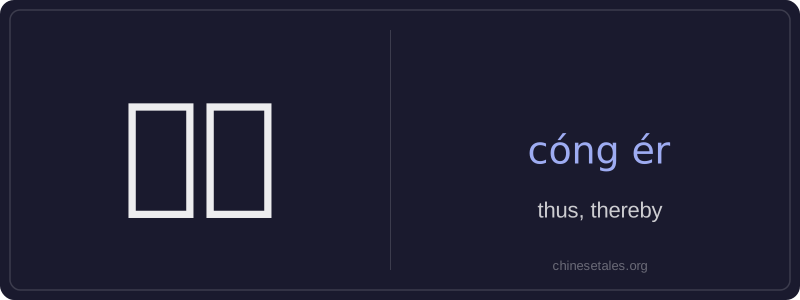
从而 is a conjunction meaning 'thus', 'thereby', or 'as a result'. It links two clauses: the first clause describes an action, condition, or situation, and the second clause expresses the logical consequence or outcome. Literally, 从 (cóng) means 'from' or 'starting from', and 而 (ér) functions here as a classical literary connector meaning 'and thus' or 'thereby' — together they form a cohesive causal link. Unlike spoken causal words like 所以 (suǒyǐ), 从而 is more formal and commonly found in written Chinese: academic texts, official documents, news reports, and reasoned arguments.
This word emphasizes a direct, often intentional or mechanistic, cause–effect relationship — not just coincidence. It implies that the result follows logically or inevitably from the preceding condition. Because of its formal register, it’s rarely used in casual speech or texting. Learners should avoid overusing it in spoken contexts where 所以 or 因此 would sound more natural. Also, 从而 cannot begin a sentence; it must connect two clauses within one sentence.
Example Sentences
Related Words
见面
见面 literally means 'see face' — combining 见 (t
背后
背后 literally means 'back + behind' and functions
我的
我的 (wǒ de) is a possessive pronoun meaning 'my'
中学
'Zhōngxué' literally combines 'zhōng' (middle)
面条
‘面条’ (miàn tiáo) literally means ‘flour str
后来
Later (hòulái) is an adverb meaning 'afterwards'
在家
'Zài jiā' literally combines the preposition 'z
不对
不对 (bù duì) literally combines 不 (bù), meani