Word Explanation
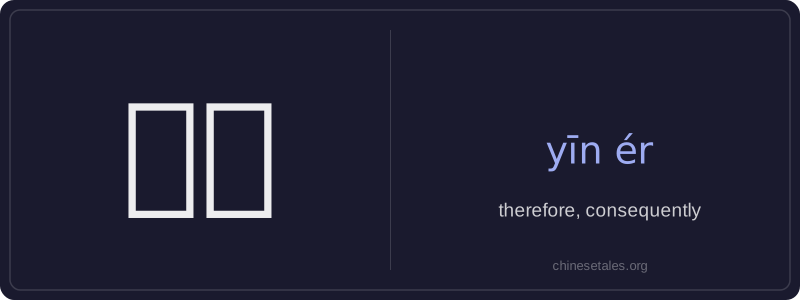
‘因而’ is a formal conjunction meaning ‘therefore’ or ‘consequently’, used to introduce a logical result that follows directly from a previously stated cause or reason. It combines the character 因 (yīn), meaning ‘because’ or ‘due to’, and 而 (ér), which here functions as a connecting particle indicating consequence—similar to ‘thus’ or ‘and so’. Together, they form a compact, written-style causal link, more common in essays, reports, and formal speech than in casual conversation.
This word typically appears at the beginning of a clause following a clear cause, often after a comma or semicolon. It emphasizes a tight, almost inevitable relationship between cause and effect—not just correlation, but direct derivation. While similar to ‘所以’, ‘因而’ sounds more objective, detached, and academic; it avoids subjective emphasis and rarely begins sentences in spoken Mandarin unless the speaker is deliberately adopting a formal tone.
Example Sentences
Related Words
见面
见面 literally means 'see face' — combining 见 (t
背后
背后 literally means 'back + behind' and functions
我的
我的 (wǒ de) is a possessive pronoun meaning 'my'
中学
'Zhōngxué' literally combines 'zhōng' (middle)
面条
‘面条’ (miàn tiáo) literally means ‘flour str
后来
Later (hòulái) is an adverb meaning 'afterwards'
在家
'Zài jiā' literally combines the preposition 'z
不对
不对 (bù duì) literally combines 不 (bù), meani