Word Explanation
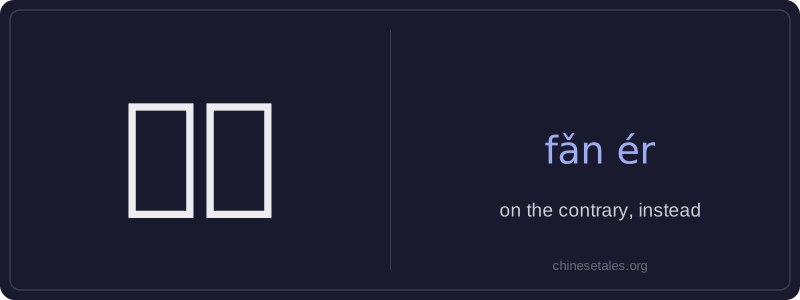
‘反而’ is a conjunction meaning 'on the contrary' or 'instead'—it introduces an outcome that is unexpected, opposite, or contradictory to what was anticipated or implied in the preceding clause. The character 反 (fǎn) means 'to reverse' or 'opposite', and 而 (ér) functions here as a classical conjunction indicating contrast or transition, similar to 'but' or 'and yet'. Together, they signal a surprising reversal of expectation: when A was expected to happen (or lead to B), the actual result is C—something contrary or counterintuitive.
This word commonly appears in cause–effect or comparative structures, often after clauses expressing effort, intention, or assumption. It’s neutral in register and widely used in both spoken and written Mandarin. Unlike standalone adverbs, ‘反而’ cannot begin a sentence—it must connect two clauses, with the first clause setting up the expectation and the second presenting the unexpected result. It frequently co-occurs with words like ‘本来’ (originally), ‘应该’ (should), or ‘以为’ (thought).
Example Sentences
Related Words
见面
见面 literally means 'see face' — combining 见 (t
背后
背后 literally means 'back + behind' and functions
我的
我的 (wǒ de) is a possessive pronoun meaning 'my'
中学
'Zhōngxué' literally combines 'zhōng' (middle)
面条
‘面条’ (miàn tiáo) literally means ‘flour str
后来
Later (hòulái) is an adverb meaning 'afterwards'
在家
'Zài jiā' literally combines the preposition 'z
不对
不对 (bù duì) literally combines 不 (bù), meani