Word Explanation
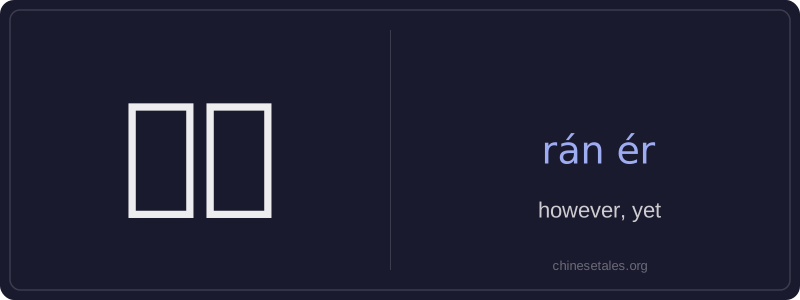
然而 (rán ér) is a formal conjunction meaning 'however' or 'yet', used to introduce a contrasting idea that follows logically from the previous clause. It functions similarly to English 'but' or 'yet', but carries a more literary or written tone and is rarely used in casual speech. The character 然 means 'thus' or 'so', and 而 means 'and' or 'but' — together, they express a sense of 'thus, yet...' or 'therefore, nevertheless...', emphasizing a logical contrast rather than simple opposition.
This word typically appears at the beginning of a sentence or after a comma in mid-sentence, connecting two complete clauses. It’s common in essays, news reports, academic writing, and thoughtful spoken discourse — for instance, when acknowledging a fact before presenting an unexpected or counterbalancing point. Learners should avoid overusing it in conversation; native speakers prefer simpler alternatives like 但是 (dànshì) or 可是 (kěshì) in everyday contexts.
Example Sentences
Related Words
见面
见面 literally means 'see face' — combining 见 (t
背后
背后 literally means 'back + behind' and functions
我的
我的 (wǒ de) is a possessive pronoun meaning 'my'
中学
'Zhōngxué' literally combines 'zhōng' (middle)
面条
‘面条’ (miàn tiáo) literally means ‘flour str
后来
Later (hòulái) is an adverb meaning 'afterwards'
在家
'Zài jiā' literally combines the preposition 'z
不对
不对 (bù duì) literally combines 不 (bù), meani