Word Explanation
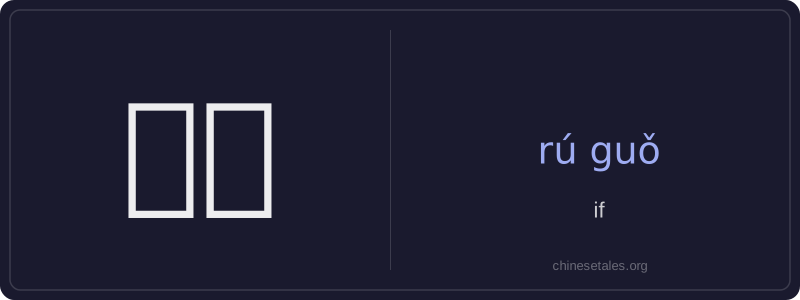
'如果' (rú guǒ) is a conjunction meaning 'if', used to introduce a hypothetical or conditional clause. It is composed of two characters: '如' (rú), meaning 'as' or 'like', and '果' (guǒ), meaning 'result' or 'consequence'. Together, they literally suggest 'as [a] result' — emphasizing the causal link between a condition and its outcome. Unlike single-character '若' or literary '倘若', '如果' is standard in modern spoken and written Mandarin, neutral in register, and widely used in everyday conversation, instructions, and formal writing.
It typically appears at the beginning of a subordinate clause, followed by a main clause expressing the consequence. The structure is usually '如果 + [condition], (then) + [result]'. While the 'then' part is often omitted in informal speech, the conditional relationship remains clear. '如果' can express real possibilities ('If it rains, we’ll stay home') or unreal/hypothetical situations ('If I had time, I’d study Chinese every day'), depending on verb aspect and context.
Example Sentences
Related Words
见面
见面 literally means 'see face' — combining 见 (t
背后
背后 literally means 'back + behind' and functions
我的
我的 (wǒ de) is a possessive pronoun meaning 'my'
中学
'Zhōngxué' literally combines 'zhōng' (middle)
面条
‘面条’ (miàn tiáo) literally means ‘flour str
后来
Later (hòulái) is an adverb meaning 'afterwards'
在家
'Zài jiā' literally combines the preposition 'z
不对
不对 (bù duì) literally combines 不 (bù), meani