Word Explanation
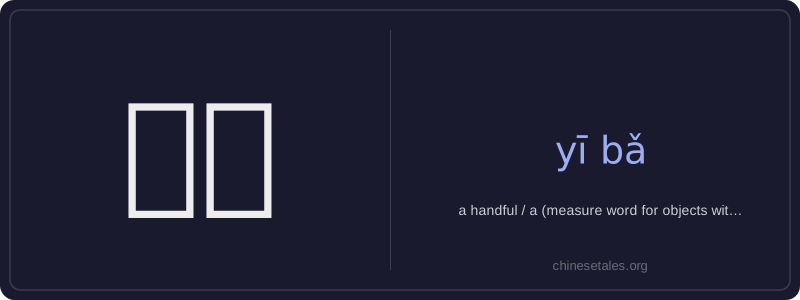
‘一把’ (yī bǎ) is a quantifier phrase meaning ‘a handful’ or ‘a (single) unit’ used specifically with nouns that have handles or can be grasped — such as knives, chairs, umbrellas, or even abstract concepts like ‘a burst of laughter’. The character 一 (yī) means ‘one’, and 把 (bǎ) is a measure word for objects held in the hand; together, they form a fixed numeral-classifier compound. Unlike general counters like 个 (gè), 把 implies physical graspability or functional unity.
This phrase appears frequently in daily speech and writing when describing tools, furniture, or actions involving holding or wielding. It may also carry idiomatic nuance: ‘一把火’ (a blaze), ‘一把泪’ (a flood of tears), where ‘a handful’ metaphorically suggests intensity or abundance. Learners should note that 把 cannot be used alone as a noun — it must always follow a numeral or demonstrative (e.g., 这把, 那把) to form a complete noun phrase.
Example Sentences
Related Words
见面
见面 literally means 'see face' — combining 见 (t
背后
背后 literally means 'back + behind' and functions
我的
我的 (wǒ de) is a possessive pronoun meaning 'my'
中学
'Zhōngxué' literally combines 'zhōng' (middle)
面条
‘面条’ (miàn tiáo) literally means ‘flour str
后来
Later (hòulái) is an adverb meaning 'afterwards'
在家
'Zài jiā' literally combines the preposition 'z
不对
不对 (bù duì) literally combines 不 (bù), meani