Word Explanation
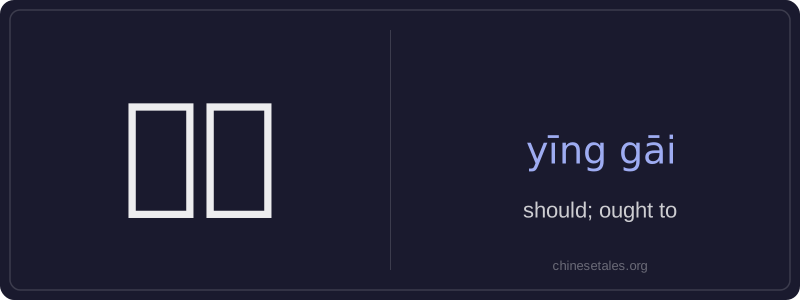
应该 (yīng gāi) is an adverb expressing obligation, expectation, or logical necessity — equivalent to 'should' or 'ought to' in English. Though composed of two characters (应 meaning 'to respond' or 'to be expected', and 该 meaning 'to be due' or 'to be proper'), it functions as a single grammatical unit and never appears separately in this sense. It conveys what is advisable, morally right, or logically inferred based on facts or social norms — not strong command (like 必须), but reasoned recommendation or expectation.
This word commonly precedes verbs or adjectives and often appears in advice, suggestions, predictions, or mild criticism (e.g., 'You should rest' or 'It should be ready by noon'). It can also express probability ('That should be the right answer'). Unlike modal verbs such as 会 or 能, 应该 carries a normative or evaluative tone — implying alignment with reason, duty, or common sense. It’s neutral in register, used widely in both spoken and written Chinese across ages and contexts.
Example Sentences
Related Words
见面
见面 literally means 'see face' — combining 见 (t
背后
背后 literally means 'back + behind' and functions
我的
我的 (wǒ de) is a possessive pronoun meaning 'my'
中学
'Zhōngxué' literally combines 'zhōng' (middle)
面条
‘面条’ (miàn tiáo) literally means ‘flour str
后来
Later (hòulái) is an adverb meaning 'afterwards'
在家
'Zài jiā' literally combines the preposition 'z
不对
不对 (bù duì) literally combines 不 (bù), meani