Word Explanation
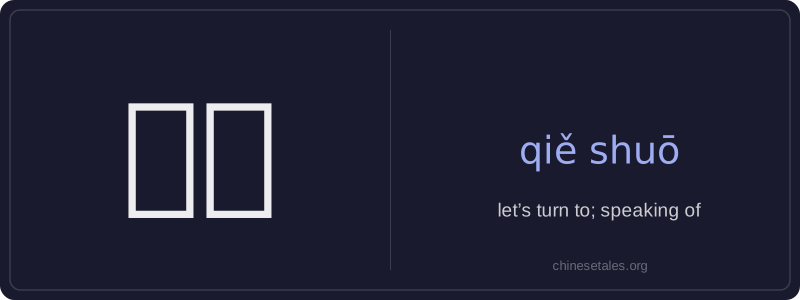
‘且说’ is a classical and literary conjunction used to shift focus or introduce a new topic or character in narrative writing—especially common in traditional Chinese novels, storytelling, and formal spoken narration. The character 且 (qiě) means ‘moreover’, ‘furthermore’, or ‘for now’, while 说 (shuō) means ‘to say’ or ‘to speak’. Together, they function not as a literal ‘say this’, but as a transitional phrase meaning ‘let’s turn to…’ or ‘speaking of…’, signaling a deliberate pivot in the storyline or discussion.
This expression carries a slightly formal, rhythmic, and almost theatrical tone—it evokes the voice of a storyteller pausing before revealing new information. It’s rarely used in casual conversation but appears frequently in historical fiction, opera scripts, and academic commentary where narrative flow and rhetorical structure matter. Learners should recognize it as a discourse marker rather than a verb phrase; it never takes an object and always precedes a clause or sentence that introduces the next subject.
Example Sentences
Related Words
见面
见面 literally means 'see face' — combining 见 (t
背后
背后 literally means 'back + behind' and functions
我的
我的 (wǒ de) is a possessive pronoun meaning 'my'
中学
'Zhōngxué' literally combines 'zhōng' (middle)
面条
‘面条’ (miàn tiáo) literally means ‘flour str
后来
Later (hòulái) is an adverb meaning 'afterwards'
在家
'Zài jiā' literally combines the preposition 'z
不对
不对 (bù duì) literally combines 不 (bù), meani