Word Explanation
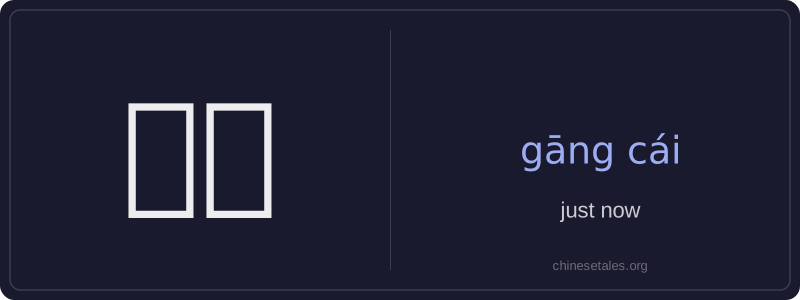
'刚才' (gāng cái) is an adverb meaning 'just now' — referring to a very recent point in the past, usually within the last few minutes. Though it looks like two separate characters, 刚 and 才, together they form a fixed compound with a single grammatical function. '刚' emphasizes immediacy or freshness of timing, while '才' adds a nuance of recency or newness — not 'only' or 'just' in the sense of limitation, but 'only just now.' The two characters are inseparable in this usage; you cannot omit one or rearrange them.
This word commonly appears before verbs to indicate that an action was completed moments ago. It often co-occurs with perfective aspect markers like 了 (le), though 了 is optional when the context makes completion clear. '刚才' can also stand alone as a time noun ('a moment ago'), but its most frequent and natural use is adverbial, modifying the verb phrase. It’s neutral in register — appropriate in both spoken and written Chinese, from casual conversation to formal reports.
Example Sentences
Related Words
背后
背后 literally means 'back + behind' and functions
见面
见面 literally means 'see face' — combining 见 (t
我的
我的 (wǒ de) is a possessive pronoun meaning 'my'
中学
'Zhōngxué' literally combines 'zhōng' (middle)
面条
‘面条’ (miàn tiáo) literally means ‘flour str
后来
Later (hòulái) is an adverb meaning 'afterwards'
在家
'Zài jiā' literally combines the preposition 'z
不对
不对 (bù duì) literally combines 不 (bù), meani