Word Explanation
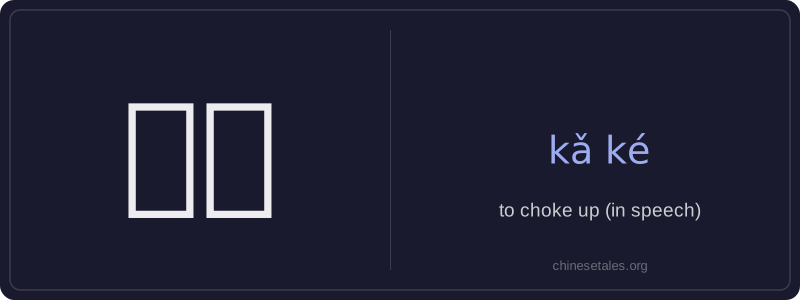
‘卡壳’ (kǎ ké) is a vivid, colloquial verb meaning to suddenly freeze or choke up while speaking—typically due to nervousness, forgetfulness, or emotional overwhelm. Literally, 卡 (kǎ) means 'to jam' or 'to get stuck', and 壳 (ké) means 'shell' or 'outer covering'; together, the phrase evokes the image of speech getting trapped inside a hard shell, unable to emerge smoothly. It’s commonly used to describe moments when someone knows what they want to say but cannot retrieve the words, stumble mid-sentence, or go silent unexpectedly.
This expression is informal and widely used in everyday spoken Chinese—especially among young people and in conversational contexts like presentations, interviews, or casual chats. It does not imply long-term speech difficulty (like a clinical disorder), but rather a temporary, situational block. While the characters can individually be read as kǎ/ké, the compound is always pronounced kǎ ké—never kǎ qiào or other variants—and functions exclusively as a verb, never a noun or adjective.
Example Sentences
Related Words
背后
背后 literally means 'back + behind' and functions
见面
见面 literally means 'see face' — combining 见 (t
面条
‘面条’ (miàn tiáo) literally means ‘flour str
我的
我的 (wǒ de) is a possessive pronoun meaning 'my'
中学
'Zhōngxué' literally combines 'zhōng' (middle)
后来
Later (hòulái) is an adverb meaning 'afterwards'
在家
'Zài jiā' literally combines the preposition 'z
不对
不对 (bù duì) literally combines 不 (bù), meani